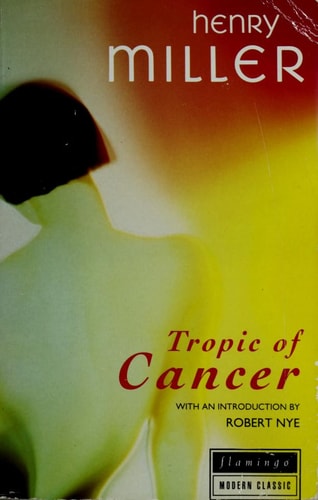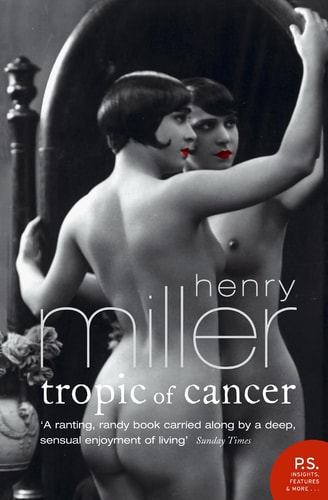
Tropic of Cancer
0
0
As an Amazon Associate and affiliate partner, Menrva Books earns from qualifying purchases. Learn more
Author Description
Miller's groundbreaking first novel, banned in Britain for almost thirty years, now reinvigorated in a new Harper Perennial Modern Classics edition. A penniless and as yet unpublished writer, Henry Miller arrived in Paris in 1930. Leaving behind a disintegrating marriage and an unhappy career in America, he threw himself into the low-life of bohemian Paris with unwavering gusto. A fictional account of Miller's adventures amongst the prostitutes and pimps, the penniless painters and writers of Montparnasse, Tropic of Cancer is an extravagant and rhapsodic hymn to a world of unrivalled eroticism and freedom. Tropic of Cancer's 1934 publication in France was hailed by Samuel Beckett as 'a momentous event in the history of modern writing'. The novel was subsequently banned in the UK and the USA and not released for publication for a further thirty years.
Menrva's Summary
THE PULSE
A penniless writer navigates the gritty, bohemian underbelly of 1930s Paris while struggling to maintain his creative identity amidst poverty and moral decay. The protagonist, a thinly veiled version of Miller himself, wanders through the streets of Montparnasse, engaging in a series of episodic encounters with prostitutes, artists, and fellow expatriates. His primary objective is the pursuit of raw experience and artistic liberation, which frequently clashes with the physical realities of hunger, homelessness, and social alienation. The narrative framework is a non-linear, stream-of-consciousness account that prioritizes visceral sensation and philosophical reflection over traditional plot progression.
INSIDE THE PAGES
- Stream of consciousness narrative style
- Episodic structure lacking a traditional linear plot
- Vivid, unflinching depictions of urban poverty
- Explicit exploration of eroticism and human desire
- Philosophical digressions on the nature of art and society
- Satirical portrayal of the expatriate community in Paris
- First-person perspective emphasizing subjective experience
- Rhapsodic, energetic prose style
THE COLLECTIVE ECHO
This novel remains a polarizing fixture in the canon of twentieth-century literature due to its transgressive content and stylistic defiance. Critics often highlight its role in challenging censorship laws and expanding the boundaries of what is permissible in published fiction. The work is frequently analyzed for its raw, unfiltered capture of the bohemian spirit and its rejection of conventional moral structures. Readers often engage with the text as a document of a specific historical moment in Paris, noting the intensity of the author's voice and the uncompromising nature of his observations. Its legacy is defined by the long-standing legal battles that preceded its eventual widespread availability.
Page Count:
336
Publication Date:
1934-09-01
Publisher:
Grove Press
ISBN-10:
0007204469
ISBN-13:
9780007204465
Literary Fiction
Classics
Bohemian
Autobiographical fiction
Modernism
Modern fiction
Fiction