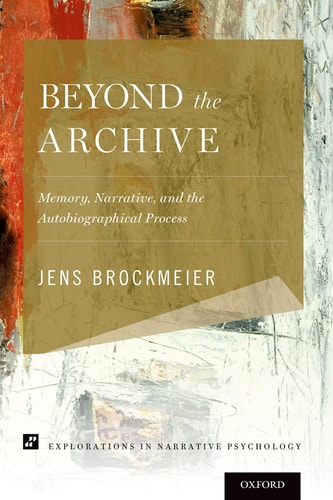
Beyond the Archive: Memory, Narrative, and the Autobiographical Process
0
0
As an Amazon Associate and affiliate partner, Menrva Books earns from qualifying purchases. Learn more
Author Description
Our longstanding view of memory and remembering is in the midst of a profound transformation. This transformation does not only affect our concept of memory or a particular idea of how we remember and forget; it is a wider cultural process. In order to understand it, one must step back and consider what is meant when we say memory. Brockmeier's far-ranging studies offer such a perspective, synthesizing understandings of remembering from the neurosciences, humanities, social studies, and in key works of autobiographical literature and life-writing. His conclusions force us to radically rethink our very notion of memory as an archive of the past, one that suggests the natural existence of a distinctive human capacity (or a set of neuronal systems) enabling us to "encode," "store," and "recall" past experiences.Now, propelled by new scientific insights and digital technologies, a new picture is emerging. It shows that there are many cultural forms of remembering and forgetting, embedded in a broad spectrum of human activities and artifacts. This picture is more complex than any notion of memory as storage of the past would allow. Indeed it comes with a number of alternatives to the archival memory, one of which Brockmeier describes as the narrative approach. The narrative approach not only permits us to explore the storied weave of our most personal form of remembering--that is, the autobiographical--it also sheds new light on the interrelations among memory, self, and culture.
Menrva's Summary
THE THESIS
This book investigates the core question of whether memory should be conceptualized as a static archive of the past or as a dynamic, narrative-driven cultural process. Jens Brockmeier, a scholar in the field of narrative psychology, draws upon an interdisciplinary framework that synthesizes findings from neuroscience, the humanities, and social studies. He argues that the traditional archival model of memory is insufficient, proposing instead a narrative approach that accounts for the complex interplay between individual experience, self-identity, and cultural artifacts.
THE SCOPE MAP
What You Will Find
- An analysis of the shift from archival memory models to narrative-based frameworks.
- Examination of autobiographical literature and life-writing as primary sites of memory construction.
- Integration of neuroscientific data with cultural and social theory.
Scope Limits
- The text does not provide a clinical manual for memory improvement or therapeutic intervention.
- It does not focus on the biological mechanics of neuronal systems in isolation from their cultural context.
THE AUTHORITY PERSPECTIVE
Experts in the field of narrative psychology recognize this work as a significant contribution to the ongoing debate regarding the nature of human memory. Readers frequently note the academic density of the prose, which requires a foundational understanding of psychological and philosophical discourse to fully appreciate the author's arguments.
Page Count:
424
Publication Date:
2018-09-15
Publisher:
Oxford University Press
ISBN-10:
0190913622
ISBN-13:
9780190913625
Psychology
Autobiography
Philosophy
Memory Studies
Memory
Community Tags
Similar Books