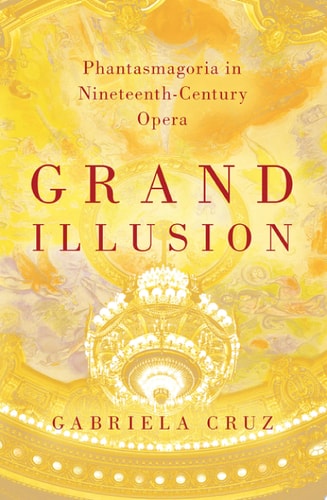
Grand Illusion: Phantasmagoria in Nineteenth-Century Opera
0
0
As an Amazon Associate and affiliate partner, Menrva Books earns from qualifying purchases. Learn more
Author Description
A new and groundbreaking approach to the history of grand opera, Grand Illusion: Phantasmagoria in Nineteenth-Century Opera explores the illusion and illumination behind the form's rise to cultural eminence. Renowned opera scholar Gabriela Cruz argues that grand opera worked to awaken memory and feeling in a way never before experienced in the opera house, asserting that the concept of "spectacle" was the defining cultural apparatus of the art form after the 1820s. Parisian audiences at the Académie Royale de Musique were struck by the novelty and power of grand opera upon the introduction of gaslight illumination, a technological innovation that quickly influenced productions across the Western operatic world. With this innovation, grand opera transformed into an audio-visual spectacle, delivering dream-like images and evoking the ghosts of its audiences' past. Through case studies of operas by Giacomo Meyerbeer, Richard Wagner, and Giuseppe Verdi, Cruz demonstrates how these works became an increasingly sophisticated medium by which audiences could conjure up the past and be transported away from the breakdown of modern life. A historically informed narrative that traverses far and wide, from dingy popular theatres in post-revolutionary Paris, to nautical shows in London, and finally to Egyptian mummies, Grand Illusion provides a fresh departure from previous scholarship, highlighting the often-neglected visual side of grand opera.
Menrva's Summary
THE THESIS
This work investigates how the integration of gaslight technology transformed nineteenth-century grand opera into a sophisticated apparatus for collective memory and sensory spectacle. Gabriela Cruz, a noted scholar in operatic studies, utilizes historical analysis and cultural theory to argue that the visual innovations of the 1820s redefined the operatic experience. By examining the intersection of technological advancement and artistic production, she posits that grand opera functioned as a medium for audiences to engage with historical ghosts and escape the anxieties of modern life.
THE SCOPE MAP
What You Will Find
- Analysis of the impact of gaslight illumination on theatrical production
- Comparative studies of works by Giacomo Meyerbeer, Richard Wagner, and Giuseppe Verdi
- Historical context of Parisian, London, and international operatic venues
- Exploration of the relationship between visual spectacle and audience psychology
Scope Limits
- The text focuses primarily on the visual and technological aspects of grand opera rather than a comprehensive musical analysis of every score
- The study is limited to the nineteenth-century period and does not extend into twentieth-century operatic developments
THE AUTHORITY PERSPECTIVE
Scholars and critics recognize this text as a significant contribution to the study of nineteenth-century performance practices and visual culture. Readers frequently note the academic density of the prose, which provides a rigorous framework for understanding the evolution of operatic staging.
Page Count:
312
Publication Date:
2020-01-01
Publisher:
Oxford University Press
ISBN-10:
0190915072
ISBN-13:
9780190915070
Criticism history
Nineteenth century
Humanities
Technology and Culture
Theatre
Broadway & Musical Revue
Music History
Opera
Community Tags
Similar Books