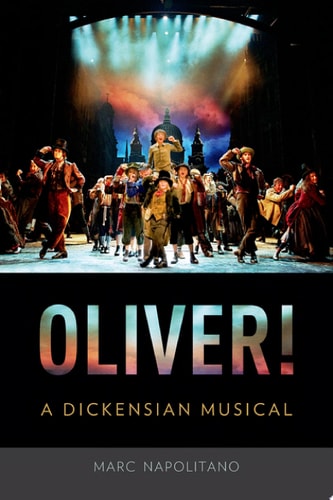
Oliver!: A Dickensian Musical
0
0
As an Amazon Associate and affiliate partner, Menrva Books earns from qualifying purchases. Learn more
Author Description
When the show was first produced in 1960, at a time when transatlantic musical theatre was dominated by American productions, Oliver! already stood out for its overt Englishness. But in writing Oliver!, librettist and composer Lionel Bart had to reconcile the Englishness of his Dickensian source with the American qualities of the integrated book musical. To do so, he turned to the musical traditions that had defined his upbringing: English music hall, Cockney street singing, and East End Yiddish theatre. This book reconstructs the complicated biography of Bart's play, from its early inception as a pop musical inspired by a marketable image, through its evolution into a sincere Dickensian adaptation that would push English musical theatre to new dramatic heights. The book also addresses Oliver!'s phenomenal reception in its homeland, where audiences responded to the musical's Englishness with a nationalistic fervor. The musical, which has more than fulfilled its promise as one of the most popular English musicals of all time, remains one of the country's most significant shows.Author Marc Napolitano shows how Oliver!'s popularity has ultimately exerted a significant influence on two separate cultural trends. Firstly, Bart's adaptation forever impacted the culture text of Dickens's Oliver Twist; to this day, the general perception of the story and the innumerable allusions to the novel in popular media are colored heavily by the sights, scenes, sounds, and songs from the musical, and virtually every major adaptation of from the 1970s on has responded to Bart's work in some way. Secondly, Oliver! helped to move the English musical forward by establishing a post-war English musical tradition that would eventually pave the way for the global dominance of the West End musical in the 1980s. As such, Napolitano's book promises to be an important book for students and scholars in musical theatre studies as well as to general readers interested in the megamusical.
Menrva's Summary
THE THESIS
This book investigates how Lionel Bart’s musical adaptation of Oliver Twist reconciled traditional English performance styles with the structure of the American integrated musical to redefine the West End landscape. Author Marc Napolitano, a scholar of musical theatre, utilizes historical production records, cultural analysis, and musicological context to argue that the show’s unique synthesis of music hall, Yiddish theatre, and Dickensian narrative established a new trajectory for post-war British musical theatre. The text examines how this specific adaptation shifted the cultural perception of the original novel and catalyzed the rise of the modern megamusical.
THE SCOPE MAP
What You Will Find
- Analysis of the 1960 production and its departure from American musical norms
- Examination of the influence of English music hall and East End Yiddish theatre on the score
- Discussion of the musical's impact on subsequent adaptations of Charles Dickens's work
- Historical context regarding the nationalistic reception of the show in Britain
Scope Limits
- The book does not provide a comprehensive biography of Lionel Bart beyond his work on this specific production
- It does not offer a scene-by-scene technical analysis of the musical score
THE AUTHORITY PERSPECTIVE
Scholars and theatre historians identify this work as a significant contribution to the study of the British musical and its evolution in the twentieth century. Readers frequently note the academic rigor of the prose, which provides a detailed look at how a single production can alter the cultural trajectory of both a classic novel and a national theatrical tradition.
Page Count:
304
Publication Date:
2014-01-01
Publisher:
Oxford University Press
ISBN-10:
0190207302
ISBN-13:
9780190207304
Music
Broadway & Musical Revue
Humanities
Great Britain
Theatre
Criticism history
Musical theatre
Theater History
British History
Community Tags
Other Editions(2)

Similar Books



Reader Comments
Share Your Thoughts
No comments yet. Be the first to share your thoughts!