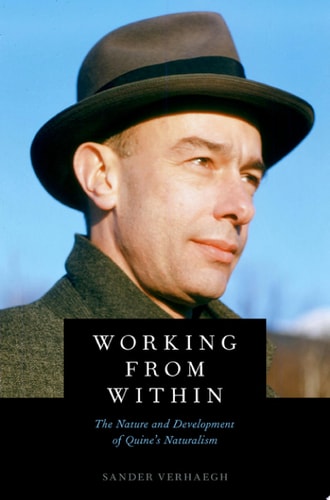
Working From Within
0
0
As an Amazon Associate and affiliate partner, Menrva Books earns from qualifying purchases. Learn more
Author Description
During The Past Few Decades, A Radical Shift Has Occurred In How Philosophers Conceive Of The Relation Between Science And Philosophy. A Great Number Of Analytic Philosophers Have Adopted What Is Commonly Called A Naturalistic Approach, Arguing That Their Inquiries Ought To Be In Some Sense Continuous With Science. Where Early Analytic Philosophers Often Relied On A Sharp Distinction Between Science And Philosophy--the Former An Empirical Discipline Concerned With Fact, The Latter An A Priori Discipline Concerned With Meaning--philosophers Today Largely Follow Willard Van Orman Quine (1908-2000) In His Seminal Rejection Of This Distinction. Sander Verhaegh Here Offers A Comprehensive Study Of Quine's Groundbreaking Naturalism. Building On Quine's Published Corpus As Well As A Wealth Of Unpublished Letters, Notes, Lectures, Papers, Proposals, And Annotations From The Quine Archives, Verhaegh Aims To Reconstruct Both The Nature And The Development Of His Naturalism. As Such, Working From Within Aims To Contribute To The Rapidly Developing Historiography Of Analytic Philosophy, And To Provide A Better, Historically Informed, Understanding Of What Is Philosophically At Stake In The Contemporary Naturalistic Turn. Transcriptions Of Five Unpublished Papers, Letters, And Notes Are Included In The Appendix.
Menrva's Summary
THE THESIS
This book investigates the historical development and philosophical foundations of W.V.O. Quine’s naturalism to clarify the contemporary shift toward integrating philosophy with scientific inquiry. Sander Verhaegh, a scholar specializing in the history of analytic philosophy, utilizes an extensive collection of primary source materials to reconstruct Quine’s intellectual trajectory. By examining both published works and previously unexamined archival documents, the author provides a rigorous framework for understanding how the rejection of the a priori-empirical distinction reshaped modern philosophical methodology.
THE SCOPE MAP
What You Will Find
- A detailed historical reconstruction of Quine’s naturalistic philosophy.
- Analysis of unpublished letters, notes, lectures, and proposals from the Quine Archives.
- Transcriptions of five previously unavailable primary source documents in the appendix.
Scope Limits
- The text focuses specifically on Quine’s development and does not provide a comprehensive survey of all contemporary naturalistic theories.
- It does not attempt to resolve current debates in naturalism but rather provides the historical context necessary to understand them.
THE AUTHORITY PERSPECTIVE
Scholars and historians of philosophy recognize this work as a significant contribution to the historiography of analytic philosophy due to its meticulous use of archival evidence. Readers frequently note the academic density of the prose, which is intended for an audience familiar with the technical nuances of Quinean thought.
Page Count:
300
Publication Date:
2018-01-01
Publisher:
Oxford University Press
ISBN-10:
0190913177
ISBN-13:
9780190913175
Philosophy
Academic
Naturalism
Philosophy history
Community Tags
Similar Books