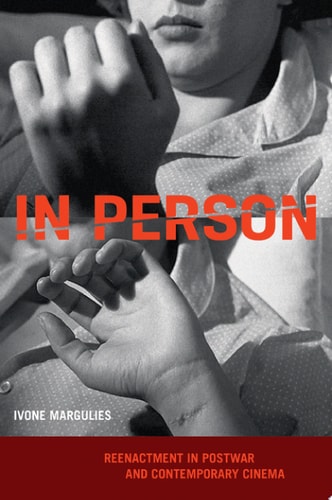
In Person: Reenactment in Postwar and Contemporary Cinema
0
0
As an Amazon Associate and affiliate partner, Menrva Books earns from qualifying purchases. Learn more
Author Description
In Person: Reenactment in Postwar and Contemporary Cinema delineates a new performative genre based on replay and self-awareness. The book argues that in-person reenactment, an actual person reenacting her past on camera, departs radically from other modes of mimetic reconstruction. In Person theorizes this figure's protean temporality and revisionist capabilities and it considers its import in terms of social representativity and exemplarity. Close readings of select, historicized examples define an alternate, confessional-performative vein to understand the self-reflexive nature of postwar and post-holocaust testimonial cinemas. The book contextualizes Zavattini's proposal that in neorealism everyone should act his own story in a sort of anti-individualist, public display (Love in the City and We the Women). It checks the convergence between verité experiments, a heightened self-critique in France and the reception of psychodrama in France (Chronicle of a summer and The Human Pyramid) in the late fifties. And, through Bazin, it reflects on the quandaries of celebrity biopics: how the circularity of the star's iconography is checked by her corporeal limits (Sophia her Own Story and the docudrama Torero!). In Person traces a shift from the exemplary and transformative ethos of fifties reenactment towards the un-redemptive stance of contemporary reenactment films such as Lanzmann's Shoah, Zhang Yuan's Sons, Andrea Tonacci's Hills of Chaos. It defines continuities between verite testimony (Chronicle, and Moi un Noir) and later para-juridical films such as the Karski Report and Rithy Panh's S21, the Khmer Rouge Killing Machine suggesting the power of co-presence and in person actualization for an ethics of viewership.
Menrva's Summary
THE THESIS
This book investigates the performative genre of in-person reenactment, where individuals recreate their own pasts on camera, and how this practice challenges traditional modes of mimetic representation. Ivone Margulies, a scholar of film and performance, utilizes a framework of temporal analysis and social representativity to examine how the act of self-reenactment functions as a revisionist tool. By analyzing the intersection of autobiography, testimony, and cinematic artifice, the author argues that these performances create a unique ethical space for the viewer.
THE SCOPE MAP
What You Will Find
- Analysis of postwar neorealist experiments and French verité cinema.
- Theoretical exploration of celebrity biopics and the limitations of star iconography.
- Examination of testimonial films regarding the Holocaust and the Khmer Rouge.
- Application of Bazin’s theories on realism and performance.
Scope Limits
- The text does not provide a comprehensive history of all documentary reenactment techniques.
- It focuses primarily on specific, historicized examples rather than a broad survey of contemporary commercial cinema.
THE AUTHORITY PERSPECTIVE
Scholars and film theorists frequently cite this work as a foundational text for understanding the intersection of performance and documentary ethics. Readers often note the academic density of the prose, which requires a strong background in film theory to fully grasp the author's arguments.
Page Count:
346
Publication Date:
2018-01-01
Publisher:
Oxford University Press
ISBN-10:
0190914025
ISBN-13:
9780190914028
History
Motion pictures
Performance Studies
Modern History
Media Studies
Film & Video
Documentary Theory
Journalism
Cinema History
Film Studies
Mass Communication
Community Tags
Other Editions(2)
Similar Books