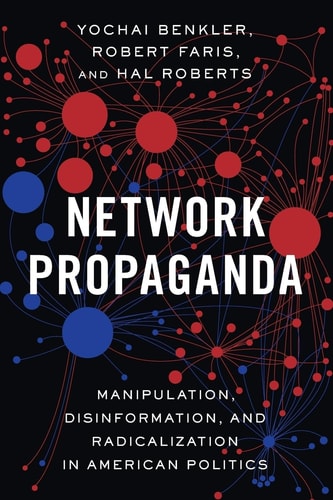
Network Propaganda: Manipulation, Disinformation, and Radicalization in American Politics
0
0
As an Amazon Associate and affiliate partner, Menrva Books earns from qualifying purchases. Learn more
Author Description
This is an open access title available under the terms of a CC BY-NC-ND 4.0 International licence. It is free to read at Oxford Scholarship Online and offered as a free PDF download from OUP and selected open access locations.Is social media destroying democracy? Are Russian propaganda or "Fake news" entrepreneurs on Facebook undermining our sense of a shared reality? A conventional wisdom has emerged since the election of Donald Trump in 2016 that new technologies and their manipulation by foreign actors played a decisive role in his victory and are responsible for the sense of a "post-truth" moment in which disinformation and propaganda thrives.Network Propaganda challenges that received wisdom through the most comprehensive study yet published on media coverage of American presidential politics from the start of the election cycle in April 2015 to the one year anniversary of the Trump presidency. Analysing millions of news stories together with Twitter and Facebook shares, broadcast television and YouTube, the book provides a comprehensive overview of the architecture of contemporary American political communications. Through data analysis and detailed qualitative case studies of coverage of immigration, Clinton scandals, and the Trump Russia investigation, the book finds that the right-wing media ecosystem operates fundamentally differently than the rest of the media environment.The authors argue that longstanding institutional, political, and cultural patterns in American politics interacted with technological change since the 1970s to create a propaganda feedback loop in American conservative media. This dynamic has marginalized centre-right media and politicians, radicalized the right wing ecosystem, and rendered it susceptible to propaganda efforts, foreign and domestic. For readers outside the United States, the book offers a new perspective and methods for diagnosing the sources of, and potential solutions for, the perceived global crisis of democratic pol
Menrva's Summary
THE THESIS
This book investigates whether social media and foreign disinformation campaigns are the primary drivers of political polarization and the erosion of shared reality in the United States. The authors, affiliated with the Berkman Klein Center for Internet & Society at Harvard University, utilize a massive dataset of media coverage and social media interactions to challenge the prevailing narrative that technological manipulation alone explains the current political climate. They argue that the American media landscape is defined by a distinct right-wing propaganda feedback loop, which is rooted in long-standing institutional and cultural patterns rather than solely in recent technological shifts.
THE SCOPE MAP
What You Will Find
- Quantitative analysis of millions of news stories, Twitter shares, Facebook posts, and broadcast television segments.
- Qualitative case studies focusing on immigration, the Clinton scandals, and the Trump-Russia investigation.
- A structural model of the American media ecosystem identifying the divergence of the right-wing media sphere.
Scope Limits
- The study focuses specifically on the American political landscape from April 2015 through the first year of the Trump presidency.
- It does not provide a comprehensive analysis of non-American political media systems or global social media platforms outside the context of US politics.
THE AUTHORITY PERSPECTIVE
Experts and scholars in media studies frequently cite this work as a foundational empirical challenge to the 'fake news' and 'Russian bot' narratives that dominated post-2016 political discourse. Readers often note the academic density of the prose and the rigorous methodological approach, which provides a necessary corrective to more speculative commentary on digital media influence.
Page Count:
472
Publication Date:
2018-10-15
Publisher:
Oxford University Press
ISBN-10:
0190923636
ISBN-13:
9780190923631
Technology and Society
Sociology
Communication
Media Studies
Journalism
Mass media
Social Media
Radicalism
Professional Career & Trade
Communication in politics
Community Tags
Similar Books








Reader Comments
Share Your Thoughts
No comments yet. Be the first to share your thoughts!