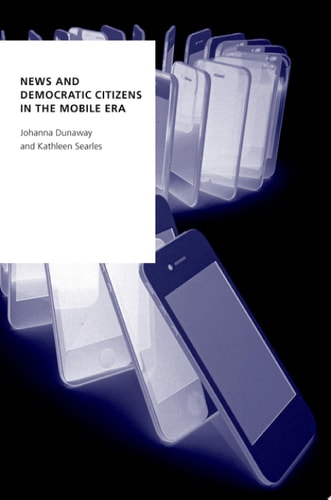
News and Democratic Citizens in the Mobile Era
0
0
As an Amazon Associate and affiliate partner, Menrva Books earns from qualifying purchases. Learn more
Author Description
Though people frequently use mobile technologies for news consumption, evidence from several fields shows that smaller screens and slower connection speeds pose major limitations for meaningful reading. In News and Democratic Citizens in the Mobile Era, Johanna Dunaway and Kathleen Searles demonstrate the effects of mobile devices on news attention, engagement, and recall, and identify a key cognitive mechanism underlying these effects: cognitive effort. They advance a theory that is both old and new: the costs of information-seeking curb participatory behaviors unless the benefits outweigh them. For news consumers in the mobile era, for example, mobile devices increase the time, economic, and cognitive costs associated with information-seeking. Only for a small few do the benefits of attending to the news on mobile devices outweigh the costs.Building on economic theories of news, media choice, and the ways audience demand shapes news craft and production, Dunaway and Searles argue that attention, engagement, and recall suffer when people consume news on mobile devices. They then investigate the implications of these effects for the news industry and for an informed democratic citizenry. Drawing on both laboratory and real-world studies, Dunaway and Searles bring the psychophysiology of news consumption to bear on the question of what we could lose in an information environment characterized by a dramatic shift in reliance on mobile devices.
Menrva's Summary
THE THESIS
This book investigates how the shift toward mobile news consumption impacts cognitive engagement, information recall, and the health of democratic participation. Johanna Dunaway and Kathleen Searles, both experts in political communication and media effects, utilize a framework rooted in economic theories of information-seeking to analyze the friction caused by mobile interfaces. They argue that the increased cognitive effort required to navigate news on smaller screens creates a barrier that discourages deep engagement, ultimately threatening the quality of an informed citizenry.
THE SCOPE MAP
What You Will Find
- Analysis of the psychophysiology of news consumption on mobile devices
- Economic theories applied to media choice and audience demand
- Empirical data comparing mobile versus desktop news engagement
- Implications for news production and industry craft
Scope Limits
- The study does not cover the long-term sociological evolution of mobile-only news consumption beyond current trends
- It does not provide specific technical design solutions for mobile news developers
THE AUTHORITY PERSPECTIVE
Scholars in political communication recognize this work as a rigorous examination of the intersection between human cognition and digital media infrastructure. Readers frequently note the academic density of the prose, which effectively bridges the gap between psychological research and political science theory.
Page Count:
170
Publication Date:
2022-12-01
Publisher:
Oxford University Press
ISBN-10:
0190922508
ISBN-13:
9780190922504
Sociology
Media Studies
Technology and Society
Communication
Community Tags
Other Editions(3)

Similar Books