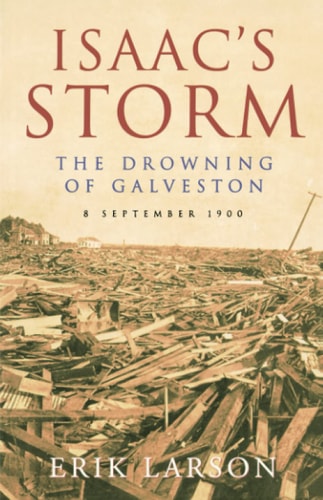
Isaac's Storm: The Drowning of Galveston, 8 September 1900
0
0
As an Amazon Associate and affiliate partner, Menrva Books earns from qualifying purchases. Learn more
Author Description
Galveston, Texas, 8 September 1900. It's another fine day in the Gulf according to Isaac Cline, chief observer of the new US Weather Bureau, but one day later, 6-10,000 people were dead, wiped out by the biggest storm the coast of America had ever witnessed. Isaac Cline was confident of his ability to predict the weather: he had new technology at his disposal, 'perfect science', and, like America itself, he was sure that he was in control of his world, that the new century would be the American century, that the future was man's to command. And the coastal city of Galveston was a prosperous, enthusiastic place - a jewel of progress and contentment, a model for the new century. The storm blew up in Cuba. It was, in modern jargon, an X-storm - an extreme hurricane - and it did not circle around the Gulf of Mexicao as storms routinely did. On 8 September 1900 it ploughed straight into Galveston. It was the meteorological equivalent of the Big One. It was to be the worst natural disaster ever to befall America to this day: between six and ten thousand people died, including Isaac Cline's wife and unborn child. With them died Cline's and America's hubris: the storm had simply blown them away. Told with a novelist's skill this is the true story of an awful and terrible natural catastrophe.
Menrva's Summary
THE THESIS
This work investigates the catastrophic failure of early twentieth-century meteorological science and human hubris to predict or mitigate the deadliest natural disaster in American history. Erik Larson utilizes the personal records of Isaac Cline, the chief observer of the Galveston Weather Bureau, alongside historical meteorological data to reconstruct the events of the 1900 hurricane. The narrative examines the collision between the era's burgeoning belief in technological mastery and the unpredictable, overwhelming force of nature.
THE SCOPE MAP
What You Will Find
- Detailed meteorological analysis of the 1900 Galveston hurricane's formation and trajectory.
- Historical context regarding the development and limitations of the United States Weather Bureau at the turn of the century.
- Primary source accounts from survivors and contemporary documentation of the storm's impact on the city.
- An examination of the psychological and professional consequences for Isaac Cline following the destruction of his community and family.
THE AUTHORITY PERSPECTIVE
This text is widely regarded as a definitive account of the Galveston disaster, praised for its meticulous research and narrative pacing. The book serves as a sobering case study on the limitations of scientific arrogance when confronted with extreme environmental phenomena.
Page Count:
384
Publication Date:
2008-07-01
Publisher:
Fourth Estate
ISBN-10:
0007292112
ISBN-13:
9780007292110
History
Non-Fiction
Biography
Texas biography
Floods
Galveston Tex
American History
Disaster
History Local
Hurricanes
Meteorology
Community Tags
Similar Books