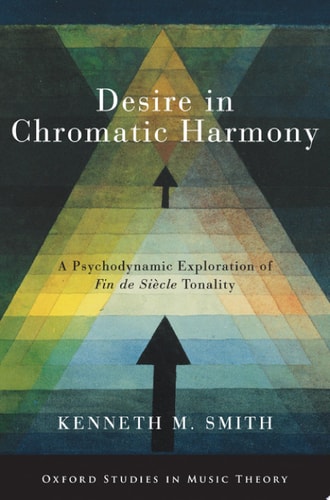
Desire in Chromatic Harmony: A Psychodynamic Exploration of Fin de Siècle Tonality
0
0
As an Amazon Associate and affiliate partner, Menrva Books earns from qualifying purchases. Learn more
Author Description
How does musical harmony engage listeners in relations of desire? Where does this desire come from? Author Kenneth Smith seeks to answer these questions by analyzing works from the turn of the twentieth- century that are both harmonically enriched and psychologically complex. Desire in Chromatic Harmony yields a new theory of how chromatic chord progressions direct the listener on intricate journeys through harmonic space, mirroring the tensions of the psyche found in Schopenhauer, Freud, Lacan, Lyotard, and Deleuze. Smith extends this mode of enquiry into sophisticated music theory, while exploring philosophically engaged European and American composers such as Richard Strauss, Alexander Skryabin, Josef Suk, Charles Ives, and Aaron Copland. Focusing on harmony and chord progression, the book drills down into the diatonic undercurrent beneath densely chromatic and dissonant surfaces. From the obsession with death and mourning in Suk's asrael Symphony to an exploration of "perversion" in Strauss's elektra; from the Sufi mysticism of Szymanowski's Song of the Night to the failed fantasy of the American dream in Copland's The Tender Land, Desire in Chromatic Harmony cuts a path through the dense forests of chromatic complexity, revealing the psychological make-up of post-Wagnerian psychodynamic music.
Menrva's Summary
THE THESIS
How does musical harmony engage listeners in relations of desire and where does this desire originate within the context of fin de siècle compositions? Kenneth M. Smith, a scholar in music theory, utilizes a psychodynamic framework to investigate the relationship between complex chromatic harmony and the human psyche. By synthesizing music theory with the philosophical and psychological insights of figures such as Schopenhauer, Freud, and Lacan, Smith argues that harmonic progressions function as mirrors for internal psychological tensions.
THE SCOPE MAP
What You Will Find
- A theoretical framework for analyzing chromatic chord progressions and harmonic space.
- Case studies of composers including Richard Strauss, Alexander Skryabin, Josef Suk, Charles Ives, and Aaron Copland.
- Analysis of the diatonic undercurrents beneath dissonant musical surfaces.
Scope Limits
- The text focuses primarily on post-Wagnerian psychodynamic music and does not provide a comprehensive history of all 20th-century harmonic developments.
THE AUTHORITY PERSPECTIVE
Scholars and music theorists frequently note the high level of academic density and the interdisciplinary nature of the prose. Experts highlight this work as a significant contribution to the study of how music theory intersects with continental philosophy and psychoanalytic theory.
Page Count:
358
Publication Date:
2020-01-01
Publisher:
Oxford University Press
ISBN-10:
019092344X
ISBN-13:
9780190923440
Philosophy
Psychology
Music theory
Academic
Music Technology
Musicology
Music
Humanities
Music History
Community Tags
Similar Books