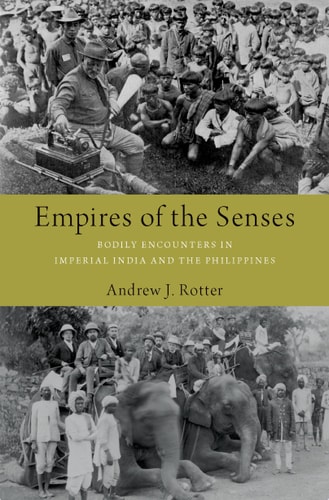
Empires of the Senses: Bodily Encounters in Imperial India and the Philippines
0
0
As an Amazon Associate and affiliate partner, Menrva Books earns from qualifying purchases. Learn more
Author Description
When encountering unfamiliar environments in India and the Philippines, the British and the Americans wrote extensively about the first taste of mango and meat spiced with cumin, the smell of excrement and coconut oil, the feel of humidity and rough cloth against skin, the sound of bells and insects, and the appearance of dark-skinned natives and lepers. So too did the colonial subjects they encountered perceive the agents of empire through their senses and their skins. Empire of course involved economics, geopolitics, violence, a desire for order and greatness, a craving for excitement and adventure. It also involved an encounter between authorities and subjects, an everyday process of social interaction, political negotiation, policing, schooling, and healing. While these all concerned what people thought about each other, perceptions of others, as Andrew Rotter shows, were also formed through seeing, hearing, touching, smelling, and tasting. In this book, Rotter offers a sensory history of the British in India from the formal imposition of their rule to its end (1857-1947) and the Americans in the Philippines from annexation to independence (1898-1946). The British and the Americans saw themselves as the civilizers of what they judged backward societies, and they believed that a vital part of the civilizing process was to properly prioritize the senses and to ensure them against offense or affront. Societies that looked shabby, were noisy and smelly, felt wrong, and consumed unwholesome food in unmannerly ways were unfit for self-government. It was the duty of allegedly more sensorily advanced Anglo-Americans to educate them before formally withdrawing their power. Indians and Filipinos had different ideas of what constituted sensory civilization and to some extent resisted imperial efforts to impose their own versions. What eventually emerged were compromises between these nations' sensory regimes.A fascinating and original comparative work, Empires of the Senses
Menrva's Summary
THE THESIS
This book investigates how sensory perception—sight, sound, smell, taste, and touch—functioned as a critical tool and justification for imperial rule in British India and the American Philippines. Andrew J. Rotter, a historian specializing in international relations and cultural history, utilizes archival documents, personal journals, and colonial records to argue that sensory regimes were central to the civilizing mission. He posits that imperial powers categorized colonized subjects as 'unfit' for self-government based on perceived sensory deficiencies, thereby framing colonial intervention as a necessary educational process.
THE SCOPE MAP
What You Will Find
- A comparative analysis of British rule in India (1857–1947) and American rule in the Philippines (1898–1946).
- An examination of sensory hierarchies in colonial administration, including hygiene, diet, and urban planning.
- Evidence drawn from colonial correspondence, travelogues, and indigenous responses to imperial sensory impositions.
Scope Limits
- The study does not provide an exhaustive history of all colonial policies, focusing instead specifically on the sensory dimensions of the imperial encounter.
- It does not cover the post-independence sensory evolution of these nations in significant detail.
THE AUTHORITY PERSPECTIVE
Scholars in the field of sensory history and post-colonial studies identify this work as a significant contribution to understanding the visceral nature of imperial power. Readers frequently note the academic density of the prose, which provides a rigorous framework for analyzing how physical sensations shaped political legitimacy.
Page Count:
386
Publication Date:
2019-01-01
Publisher:
Oxford University Press
ISBN-10:
0190924721
ISBN-13:
9780190924720
History
European History
Asian History
American History
Social Life
India
Imperialism
Cultural History
Community Tags
Similar Books