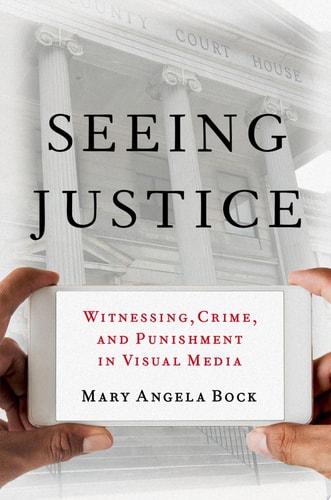
Seeing Justice: Witnessing, Crime and Punishment in Visual Media
0
0
As an Amazon Associate and affiliate partner, Menrva Books earns from qualifying purchases. Learn more
Author Description
A behind-the-scenes look at the struggles between visual journalists and officials over what the public sees--and therefore much of what the public knows--of the criminal justice system. In the contexts of crime, social justice, and the law, nothing in visual media is as it seems. In today's mediated social world, visual communication has shifted to a democratic sphere that has significantly changed the way we understand and use images as evidence. In Seeing Justice, Mary Angela Bock examines the way criminal justice in the US is presented in visual media by focusing on the grounded practices of visual journalists in relationship with law enforcement. Drawing upon extended interviews, participant observation, contemporary court cases, and critical discourse analysis, Bock provides a detailed examination of the way digitization is altering the relationships between media, consumers, and the criminal justice system. From tabloid coverage of the last public hanging in the US to Karen-shaming videos, from mug shots to perp walks, she focuses on the practical struggles between journalists, police, and court officials to control the way images influence their resulting narratives. Revealing the way powerful interests shape what the public sees, Seeing Justice offers a model for understanding how images are used in news narrative.
Menrva's Summary
THE THESIS
This book investigates how the power dynamics between visual journalists and law enforcement officials dictate the public's visual understanding of the criminal justice system. Mary Angela Bock, a scholar in media and communication, utilizes a framework of critical discourse analysis to examine the intersection of visual evidence and institutional control. By synthesizing ethnographic research with legal case studies, she argues that the digitization of media has fundamentally altered the democratic sphere and the construction of news narratives.
THE SCOPE MAP
What You Will Find
- Analysis of visual media practices from historical public hangings to contemporary viral videos.
- Examination of the tension between journalists and police regarding image control.
- Application of critical discourse analysis to news narratives and court proceedings.
Scope Limits
- The study focuses primarily on the United States criminal justice system.
- It does not provide a comprehensive history of global visual journalism.
THE AUTHORITY PERSPECTIVE
Experts recognize this work as a significant contribution to the study of visual communication and institutional power. Readers frequently note the academic rigor of the research and the clarity with which the author connects complex media theory to practical journalistic struggles.
Page Count:
304
Publication Date:
2021-01-01
Publisher:
Oxford University Press
ISBN-10:
0190927003
ISBN-13:
9780190927004
Introduction to Human Communication
Mass Communication
Visual Culture
Communications
Administration of Justice
Sociology
Journalism
Social justice
Communication
Mass media
Media Studies
Community Tags
Similar Books