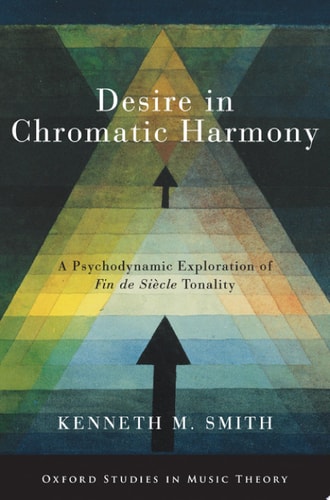
Desire in Chromatic Harmony: A Psychodynamic Exploration of Fin de Siecle Tonality
0
0
As an Amazon Associate and affiliate partner, Menrva Books earns from qualifying purchases. Learn more
Author Description
How does musical harmony engage listeners in relations of desire? Where does this desire come from? Author Kenneth Smith seeks to answer these questions by analyzing works from the turn of the twentieth- century that are both harmonically enriched and psychologically complex. Desire in Chromatic Harmony yields a new theory of how chromatic chord progressions direct the listener on intricate journeys through harmonic space, mirroring the tensions of the psyche found in Schopenhauer, Freud, Lacan, Lyotard, and Deleuze. Smith extends this mode of enquiry into sophisticated music theory, while exploring philosophically engaged European and American composers such as Richard Strauss, Alexander Skryabin, Josef Suk, Charles Ives, and Aaron Copland. Focusing on harmony and chord progression, the book drills down into the diatonic undercurrent beneath densely chromatic and dissonant surfaces. From the obsession with death and mourning in Suk's asrael Symphony to an exploration of "perversion" in Strauss's elektra; from the Sufi mysticism of Szymanowski's Song of the Night to the failed fantasy of the American dream in Copland's The Tender Land, Desire in Chromatic Harmony cuts a path through the dense forests of chromatic complexity, revealing the psychological make-up of post-Wagnerian psychodynamic music.
Menrva's Summary
THE THESIS
How does musical harmony engage listeners in relations of desire, and what is the origin of this psychological engagement? Kenneth M. Smith, a scholar of music theory, investigates the intersection of late-nineteenth and early-twentieth-century chromaticism with psychodynamic theory. By synthesizing the philosophical frameworks of Schopenhauer, Freud, Lacan, Lyotard, and Deleuze, Smith argues that complex harmonic progressions function as mirrors for the tensions of the human psyche.
THE SCOPE MAP
What You Will Find
- A theoretical framework for analyzing chromatic chord progressions as psychological drivers.
- Comparative analysis of European and American composers including Richard Strauss, Alexander Skryabin, Josef Suk, Charles Ives, and Aaron Copland.
- Methodological focus on identifying diatonic undercurrents within dissonant and highly chromatic musical surfaces.
Scope Limits
- The analysis is restricted to post-Wagnerian compositions and specific works representing turn-of-the-century harmonic complexity.
- The text does not provide a general history of music but focuses specifically on the psychodynamic implications of harmony.
THE AUTHORITY PERSPECTIVE
Experts in musicology recognize this text as a specialized contribution to the study of chromaticism and its psychological dimensions. Readers frequently note the high level of academic density, as the prose requires a strong background in both music theory and continental philosophy to fully grasp the author's arguments.
Page Count:
360
Publication Date:
2020-05-19
Publisher:
Oxford University Press
ISBN-10:
0190923423
ISBN-13:
9780190923426
Psychology
Philosophy
Harmony
Musicology
Academic
Music
Music theory
Community Tags
Similar Books