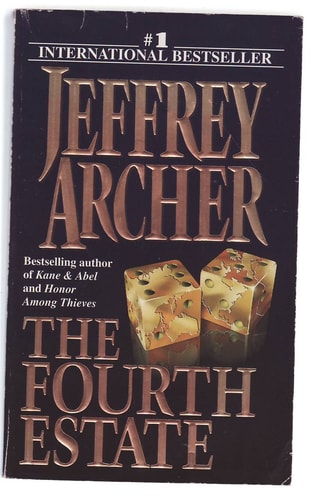
The Fourth Estate
0
0
As an Amazon Associate and affiliate partner, Menrva Books earns from qualifying purchases. Learn more
Author Description
Jeffrey Archer suggests that this bestseller is 80% fact and 20% fiction. But his descriptions of rival media moguls must hit the mark pretty accurately since Kevin Maxwell, son of the late media baron Robert Maxwell, tried to have it banned. In The Fourth Estate we meet Australian Keith Townsend whose sharp mind and cold-hearted business acumen helped forge one of the worlds biggest newspaper empires. His rival is Richard Armstrong, a courageous escapee of Nazi-occupied Eastern Europe. Both Brilliant and determined, here are two men whose quest for influence and power could propel their empires to the brink of financial disaster and catastrophe.
Menrva's Summary
THE PULSE
Two ambitious media moguls engage in a high-stakes battle for global dominance, risking their empires and reputations in a relentless pursuit of power. Keith Townsend, an Australian with a sharp mind for business, and Richard Armstrong, a survivor of Nazi-occupied Europe, build competing newspaper empires that span continents. Their parallel lives intersect as they navigate the cutthroat world of international media, where every decision carries the weight of financial ruin or total victory. The narrative follows their trajectories through decades of expansion, utilizing a third-person perspective that tracks the mechanics of their corporate maneuvers and personal rivalries.
INSIDE THE PAGES
- Dual-protagonist structure contrasting two distinct paths to power
- Detailed exploration of the newspaper industry and media consolidation
- Pacing focused on external action and corporate strategy
- Incorporation of real-world historical events and media industry parallels
- Large supporting cast representing various facets of the media landscape
- Themes of ambition, survival, and the influence of the press
- Linear narrative progression covering several decades
- High-stakes conflict involving legal and financial threats
THE COLLECTIVE ECHO
This novel is widely recognized for its striking parallels to the lives of real-world media barons, a fact that famously led to legal attempts to block its publication. Readers often note the author's methodical approach to plotting, which prioritizes the mechanics of corporate warfare over deep psychological introspection. The dual-protagonist structure is frequently cited as a successful device for maintaining tension across a sprawling timeline. While some critics observe that the narrative pace leaves little room for philosophical exploration, the book remains a staple for those interested in the intersection of fiction and media history.
Page Count:
560
Publication Date:
1996-01-01
Publisher:
HarperCollins Publishers
ISBN-10:
0007324022
ISBN-13:
9780007324026
Suspense
Thriller
Contemporary
Business
Fiction
Psychological Thrillers
Political
Historical
Mystery Thriller & Suspense
Literature & Fiction
Action Adventure
Media
Community Tags
Other Editions(4)


Similar Books