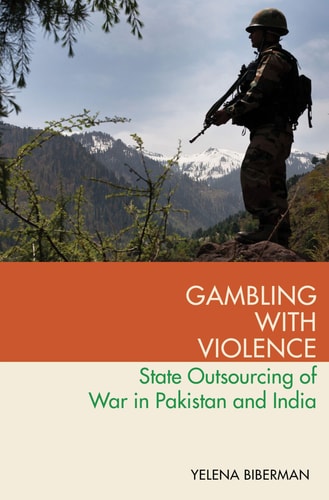
Gambling with Violence: State Outsourcing of War in Pakistan and India
0
0
As an Amazon Associate and affiliate partner, Menrva Books earns from qualifying purchases. Learn more
Author Description
In Gambling with Violence, Yelena Biberman tackles a global problem that is particularly consequential for Pakistan and India: state outsourcing of violence to ordinary civilians, criminals, and ex-insurgents. Why would these countries gamble with their own national security by outsourcing violence - arming nonstate actors inside their own borders? Drawing on over 200 interviews, archival research, and fieldwork conducted across Asia, Europe, and North America, Biberman introduces the "balance-of-interests" thesis to deepen our understanding of state-nonstate alliances in civil war. This framework centers on the distribution of power during war and shows how various combinations of interests result in distinct types of coalitions. Incorporating case studies of civil war and counterinsurgency, her book sheds light on how militias, alliances, and South Asian security connect today.
Menrva's Summary
THE THESIS
Why do states in Pakistan and India choose to outsource violence to nonstate actors, effectively gambling with their own national security? Yelena Biberman, a scholar specializing in South Asian security, investigates the strategic logic behind state-nonstate alliances. By utilizing the 'balance-of-interests' thesis, she argues that the distribution of power and the alignment of interests between the state and militias dictate the formation and stability of these dangerous coalitions.
THE SCOPE MAP
What You Will Find
- The 'balance-of-interests' theoretical framework for analyzing state-militia alliances.
- Comparative analysis of civil war and counterinsurgency dynamics in South Asia.
- Data derived from over 200 interviews and extensive archival research.
Scope Limits
- The analysis is primarily focused on the specific geopolitical contexts of Pakistan and India.
- The study does not provide a comprehensive global history of all private military contractors or mercenary groups.
THE AUTHORITY PERSPECTIVE
Experts in international relations and security studies frequently cite this work for its rigorous empirical approach to a complex, under-researched phenomenon. Readers often note the academic density of the prose, which provides a sophisticated, evidence-based examination of state behavior in volatile regions.
Page Count:
240
Publication Date:
2019-07-02
Publisher:
Oxford University Press
ISBN-10:
0190929979
ISBN-13:
9780190929978
Asian Studies
Military History
Civil War
International relations
Comparative Politics
Insurgency
Security Studies
Southeast Asia
Community Tags
Similar Books