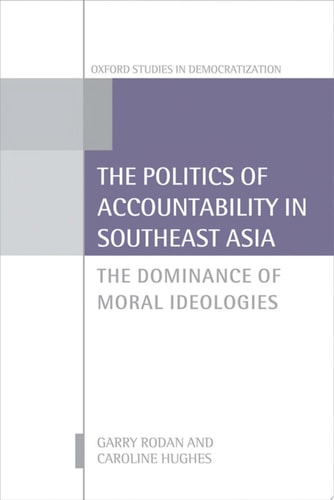
The Politics of Accountability in Southeast Asia: The Dominance of Moral Ideologies
0
0
As an Amazon Associate and affiliate partner, Menrva Books earns from qualifying purchases. Learn more
Author Description
Calls by political leaders, social activists, and international policy and aid actors for accountability reforms to improve governance have never been more widespread. For some analysts, the unprecedented scale of these pressures reflects the functional imperatives and power of liberal and democratic institutions accompanying greater global economic integration. This book offers a different perspective, investigating the crucial role of contrasting ideologies informing accountability movements and mediating reform directions in Southeast Asia. It argues that the most influential ideologies are not those promoting the political authority of democratic sovereign people or of liberalism's freely contracting individuals. Instead, in both post-authoritarian and authoritarian regimes, it is ideologies advancing the political authority of moral guardians interpreting or ordaining correct modes of behaviour for public officials. Elites exploit such ideologies to deflect and contain pressures for democratic and liberal reforms to governance institutions. The book's case studies include human rights, political decentralization, anticorruption, and social accountability reform movements in Cambodia, Indonesia, Malaysia, the Philippines, Singapore, Thailand, and Vietnam. These studies highlight how effective propagation of moral ideologies is boosted by the presence of powerful organizations, notably religious bodies, political parties, and broadcast media. Meanwhile, civil society organizations of comparable clout advancing liberalism or democracy are lacking. The theoretical framework of the book has wide applicability. In other regions, with contrasting histories and political economies, the nature and extent of organizations and social actors shaping accountability politics will differ, but the importance of these factors to which ideologies prevail to shape reform directions will not.
Menrva's Summary
THE THESIS
This book investigates why accountability reforms in Southeast Asia are frequently shaped by moral ideologies rather than liberal or democratic principles. Authors Caroline Hughes and Garry Rodan, both established scholars in Southeast Asian politics, utilize a comparative political economy framework to analyze how political elites in the region leverage moral guardianship to maintain authority. They argue that these moral ideologies serve as a strategic mechanism to deflect pressures for institutional reform, effectively containing democratic movements across diverse regime types.
THE SCOPE MAP
What You Will Find
- Comparative analysis of accountability movements in Cambodia, Indonesia, Malaysia, the Philippines, Singapore, Thailand, and Vietnam.
- Examination of the role of religious bodies, political parties, and broadcast media in propagating moral ideologies.
- A theoretical framework linking organizational power to the success of specific political ideologies.
Scope Limits
- The study does not provide an exhaustive history of every individual reform movement within the seven countries mentioned.
- It does not focus on the economic performance metrics of the regimes, but rather on the political discourse surrounding governance.
THE AUTHORITY PERSPECTIVE
Experts recognize this work as a significant contribution to the study of comparative democratization and political discourse in Southeast Asia. Readers frequently note the academic density of the prose, which makes it a specialized resource for scholars and advanced students of political science.
Page Count:
224
Publication Date:
2014-01-01
Publisher:
OUP Oxford
ISBN-10:
0191008575
ISBN-13:
9780191008573
Governance
International relations
Asian Studies
Southeast Asia
Comparative Politics
Community Tags
Similar Books