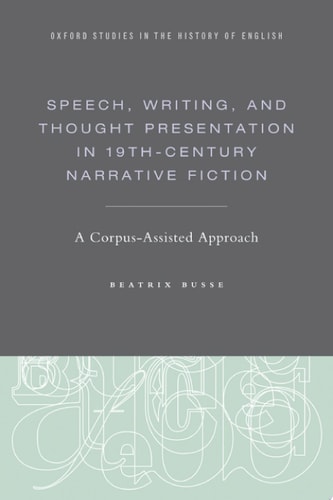
Speech, Writing, and Thought Presentation in 19th-Century Narrative Fiction: A Corpus-Assisted Approach
0
0
As an Amazon Associate and affiliate partner, Menrva Books earns from qualifying purchases. Learn more
Author Description
Reference to or quotation from someone's speech, thoughts, or writing is a key component of narrative. These reports further a narrative, make it more interesting, natural, and vivid, ask the reader to engage with it, and reflect historical cultural understandings of modes of discourse presentation. To a large extent, the way we perceive a story depends on the ways it presents discourse, and along with it, speech, writing, and thought. In this book, Beatrix Busse investigates speech, writing, and thought presentation in a corpus of 19th-century narrative fiction including Frankenstein, Jane Eyre, Wuthering Heights, Oliver Twist, and many others. At the intersection between corpus linguistics and stylistics, this book develops a new corpus-stylistic approach for systematically analyzing the different narrative strategies of discourse presentation in key pieces of 19th-century narrative fiction. Speech, Writing, and Thought Presentation in 19th-Century Narrative Fiction identifies diachronic patterns as well as unique authorial styles, and places them within their cultural-historical context. It also suggests ways for automatically identifying forms of discourse presentation, and shows that the presentation of characters' minds reflects an ideological as well as an epistemological concern about what cannot be reported, portrayed, or narrated. Through insightful interdisciplinary analysis, Busse demonstrates that discourse presentation fulfills the function of prospection and encapsulation, marks narrative progression, and shapes readers' expectations.
Menrva's Summary
THE THESIS
This book investigates how the presentation of speech, writing, and thought functions as a primary narrative mechanism in 19th-century fiction, specifically examining how these modes reflect historical cultural understandings and authorial intent. Beatrix Busse, a scholar in English linguistics, utilizes a corpus-assisted methodology to analyze a diverse selection of 19th-century novels. By bridging corpus linguistics and literary stylistics, the author develops a systematic framework for identifying and categorizing discourse presentation strategies. The work argues that these narrative techniques are not merely stylistic choices but are deeply tied to the ideological and epistemological concerns of the era.
THE SCOPE MAP
What You Will Find
- A corpus-based analysis of major 19th-century texts including Frankenstein, Jane Eyre, and Oliver Twist.
- A novel corpus-stylistic methodology for the systematic identification of discourse presentation.
- An examination of diachronic patterns and unique authorial styles in narrative discourse.
Scope Limits
- The analysis is restricted to 19th-century narrative fiction and does not extend to contemporary or earlier literary periods.
- The study focuses primarily on the mechanics of discourse presentation rather than broad thematic literary analysis.
THE AUTHORITY PERSPECTIVE
Experts in the field of stylistics and corpus linguistics recognize this work as a rigorous application of computational methods to literary analysis. Scholars frequently note the academic density of the prose, which serves as a specialized resource for researchers interested in the intersection of digital humanities and Victorian literature.
Page Count:
250
Publication Date:
2020-01-01
Publisher:
Oxford University Press
ISBN-10:
0190920823
ISBN-13:
9780190920821
Corpus linguistics
19th Century
English literature
Literary Criticism
English
Academic
Stylistics
Linguistics
English & College Success
Community Tags
Other Editions(2)
Similar Books