Denmark Vesey's Garden
0
0
As an Amazon Associate and affiliate partner, Menrva Books earns from qualifying purchases. Learn more
Author Description
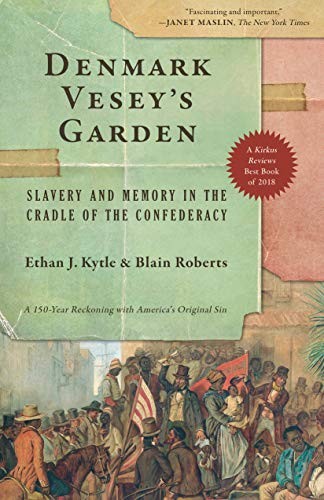
A book that strikes at the heart of the recent flare-ups over Confederate symbols in Charlottesville, New Orleans, and elsewhere, Denmark Vesey's Garden reveals the deep roots of these controversies and traces them to the heart of slavery in the United States: Charleston, South Carolina, where almost half of the U.S. slave population stepped onto our shores, where the first shot at Fort Sumter began the Civil War, and where Dylann Roof shot nine people at Emanuel A.M.E. Church, the congregation of Denmark Vesey, a black revolutionary who plotted a massive slave insurrection in 1822. As early as 1865, former slaveholders and their descendants began working to preserve a romanticized memory of the antebellum South. In contrast, former slaves, their descendants, and some white allies have worked to preserve an honest, unvarnished account of slavery as the cruel system it was. Examining public rituals, controversial monuments, and whitewashed historical tourism, Denmark Vesey's Garden tracks these two rival memories from the Civil War all the way to contemporary times, where two segregated tourism industries still reflect these opposing impressions of the past, exposing a hidden dimension of America's deep racial divide. Denmark Vesey's Garden joins the small bookshelf of major, paradigm-shifting new interpretations of slavery's enduring legacy in the United States. --inside jacket.
Menrva's Summary
THE THESIS
This book investigates the enduring conflict between competing historical memories of slavery in the United States, focusing on Charleston, South Carolina. It examines how, since the Civil War, former slaveholders and their descendants have worked to preserve a romanticized view of the antebellum South, while formerly enslaved people and their allies have strived to maintain an honest account of slavery's brutality. The book analyzes public rituals, monuments, and historical tourism to trace this division from the Civil War to the present day, revealing how segregated tourism industries continue to reflect these opposing impressions of the past and expose a hidden dimension of America's racial divide.
THE SCOPE MAP
- An examination of the deep roots of controversies surrounding Confederate symbols, tracing them to Charleston, South Carolina.
- Analysis of public rituals, controversial monuments, and historical tourism as sites of memory.
- A historical tracking of competing memories of slavery from the Civil War to contemporary times.
- Exploration of how two segregated tourism industries reflect opposing impressions of the past.
- Focus on Charleston, South Carolina, as a pivotal location for understanding slavery's legacy.
- Discussion of Denmark Vesey, a black revolutionary who plotted a slave insurrection in 1822.
THE AUTHORITY PERSPECTIVE
The book is positioned as a major, paradigm-shifting interpretation of slavery's enduring legacy in the United States. It directly addresses contemporary flare-ups over Confederate symbols by revealing their deep historical roots in Charleston and the broader context of slavery. The work analyzes the ongoing conflict between those who romanticize the antebellum South and those who advocate for an unvarnished account of slavery's cruelty. By examining public rituals, monuments, and tourism, the book exposes how these rival memories continue to shape America's racial divide.
Page Count:
0
Publication Date:
2018-01-01
ISBN-10:
1684411165
ISBN-13:
9781684411160
History
Non-Fiction
Slavery
American History
Race Relations
Community Tags
Similar Books