Inventing the Immigration Problem
0
0
As an Amazon Associate and affiliate partner, Menrva Books earns from qualifying purchases. Learn more
Author Description
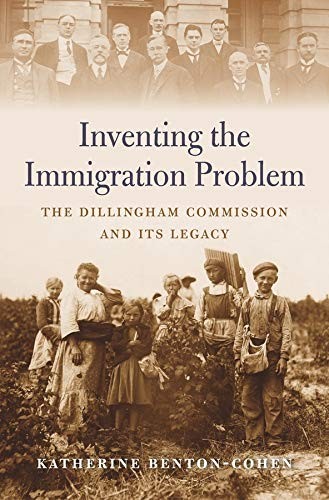
In 1907 the U.S. Congress created a joint commission to investigate what many Americans saw as a national crisis: an unprecedented number of immigrants flowing into the United States. Experts--women and men trained in the new field of social science--fanned out across the country to collect data on these fresh arrivals. The trove of information they amassed shaped how Americans thought about immigrants, themselves, and the nation's place in the world. Katherine Benton-Cohen argues that the Dillingham Commission's legacy continues to inform the ways that U.S. policy addresses questions raised by immigration, over a century later. Within a decade of its launch, almost all of the commission's recommendations--including a literacy test, a quota system based on national origin, the continuation of Asian exclusion, and greater federal oversight of immigration policy--were implemented into law. Inventing the Immigration Problem describes the labyrinthine bureaucracy, broad administrative authority, and quantitative record-keeping that followed in the wake of these regulations. Their implementation marks a final turn away from an immigration policy motivated by executive-branch concerns over foreign policy and toward one dictated by domestic labor politics. The Dillingham Commission--which remains the largest immigration study ever conducted in the United States--reflects its particular moment in time when mass immigration, the birth of modern social science, and an aggressive foreign policy fostered a newly robust and optimistic notion of federal power. Its quintessentially Progressive formulation of America's immigration problem, and its recommendations, endure today in almost every component of immigration policy, control, and enforcement.--
Menrva's Summary
THE THESIS
The Dillingham Commission's investigation into immigration in 1907 fundamentally reshaped American policy and public perception. Katherine Benton-Cohen's work details how this commission, comprised of social scientists, amassed extensive data on immigrants, leading to recommendations that profoundly influenced U.S. immigration laws for over a century. The book examines the bureaucratic structures, administrative powers, and data-driven record-keeping that emerged from these regulations, marking a shift from foreign-policy-driven immigration to one dictated by domestic labor politics. It positions the commission as a product of its era, reflecting the confluence of mass immigration, the rise of modern social science, and an assertive foreign policy that fostered a belief in robust federal power.
THE SCOPE MAP
- The creation and mandate of the 1907 Dillingham Commission.
- The methods and data collection employed by social scientists investigating immigrants.
- The commission's key recommendations, including literacy tests, national origin quotas, and continued Asian exclusion.
- The implementation of these recommendations into U.S. law.
- The shift in immigration policy motivation from foreign policy to domestic labor politics.
- The historical context of Progressive Era federal power and the birth of modern social science.
- The enduring legacy of the Dillingham Commission on contemporary U.S. immigration policy, control, and enforcement.
THE AUTHORITY PERSPECTIVE
The book is recognized for its detailed examination of a pivotal moment in American immigration history. It highlights how the Dillingham Commission's findings and recommendations, born from the Progressive Era's faith in federal power and social science, continue to shape current immigration debates and policies. The work is noted for tracing the evolution of immigration policy from executive-branch concerns to domestic labor politics. Its comprehensive scope and analysis of the commission's lasting impact provide a critical perspective on the historical construction of immigration issues in the United States.
Page Count:
342
Publication Date:
2018-01-01
ISBN-10:
0674976444
ISBN-13:
9780674976443
History
Politics
Art
Non-Fiction
Social Science
Community Tags
Similar Books