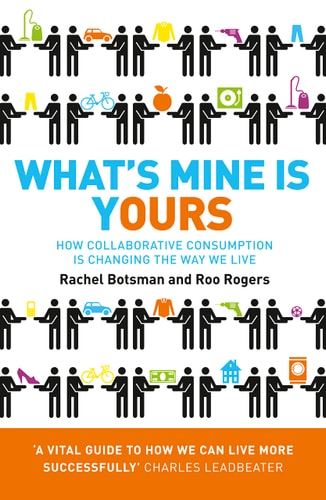
What's Mine Is Yours: The Rise of Collaborative Consumption
0
0
As an Amazon Associate and affiliate partner, Menrva Books earns from qualifying purchases. Learn more
Author Description
In the 20th century humanity consumed products faster than ever, but this way of living is no longer sustainable. This new and important book shows how technological advances are driving forms of 'collaborative consumption' which will change forever the ways in which we interact both with businesses and with each other. The average lawn mower is used for four hours a year. The average power drill is used for only twenty minutes in its entire lifespan. The average car is unused for 22 hours a day, and even when it is being used there are normally three empty seats. Surely there must be a way to get the benefit out of things like mowers, drills and even cars, without having to carry the huge up-front costs of ownership? There is indeed. Collaborative consumption is not just a buzzword, it is a new win-win way of life. This insightful and thought-provoking new book by Rachel Botsman and Roo Rogers is an important and fast-moving survey of the dramatic changes we are seeing in the way we consume products. Many of us are familiar with freecycle, eBay, couchsurfing and Zipcar. But these are just the beginning of a new phenomenon. Rachel Botsman and Roo Rogers have interviewed business leaders and opinion formers around the world to draw together the many strands of Collaborative Consumption into a coherent and challenging argument to show that the way we did business and consumerism in the 20th century is not the way we will do it in the 21st century.
Menrva's Summary
THE THESIS
This book investigates how the shift from hyper-consumption to collaborative consumption models is fundamentally altering the global economic landscape. Rachel Botsman and Roo Rogers utilize their expertise in social innovation and business strategy to analyze the inefficiencies of 20th-century ownership models. By synthesizing data on product utilization rates and interviewing global industry leaders, they argue that technological platforms are enabling a transition toward access-based economies that prioritize utility over possession.
THE SCOPE MAP
What You Will Find
- Analysis of underutilized assets like vehicles, power tools, and household equipment.
- Examination of digital platforms such as eBay, Zipcar, and Couchsurfing as catalysts for change.
- Case studies of emerging business models that prioritize sharing and peer-to-peer exchange.
- A framework for understanding the transition from traditional consumerism to a collaborative, sustainable lifestyle.
THE AUTHORITY PERSPECTIVE
The text provides a comprehensive overview of the sharing economy, offering a structured look at the intersection of technology and social behavior. Its analysis of market shifts and consumer habits serves as a foundational resource for understanding the early 21st-century transition toward access-based economic systems.
Page Count:
304
Publication Date:
2010-09-30
Publisher:
Collins
ISBN-10:
0007395914
ISBN-13:
9780007395910
Business
Economics
Sociology
Consumerism
Technology
Macroeconomics
Sustainability
Consumer Behavior
Economics
Community Tags
Similar Books