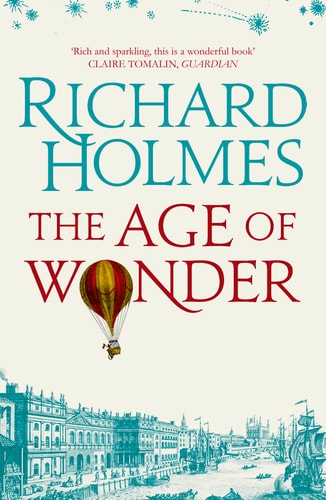
The Age of Wonder: How the Romantic Generation Discovered the Beauty and Terror of Science
0
0
As an Amazon Associate and affiliate partner, Menrva Books earns from qualifying purchases. Learn more
Author Description
THE AGE OF WONDER is Richard Holmes's first major work of biography in over a decade. It has been inspired by the scientific ferment that swept through Britain at the end of the eighteenth century, 'The Age of Wonder' and which Holmes now radically redefines as 'the revolution of Romantic Science'.The book opens with Joseph Banks, botanist on Captain Cook's first Endeavour voyage, stepping onto a Tahitian beach in 1769, hoping to discover Paradise. Many other voyages of discovery swiftly follow, while Banks, now President of the Royal Society in London, becomes our narrative guide to what truly emerges as an Age of Wonder.Banks introduces us to the two scientific figures that dominate the book: astronomer William Herschel and chemist Humphry Davy. Herschel's tireless dedication to the stars, assisted (and perhaps rivalled) by his comet-finding sister Caroline, changed forever the public conception of the solar system, the Milky Way galaxy and the meaning of the universe itself. Davy first shocked the scientific community with his near-suicidal gas experiments in Bristol, then went on to save thousands of lives with his Safety Lamp and established British chemistry as the leading professional science in Europe. But at the cost, perhaps, of his own heart.Holmes proposes a radical vision of science before Darwin, exploring the earliest ideas of deep time and deep space, the creative rivalry with the French scientific establishment, and the startling impact of discovery on great writers and poets such as Mary Shelley, Coleridge, Byron and Keats. With his trademark sense of the human drama, he shows how great ideas and experiments are born out of lonely passion, how scientific discoveries (and errors) are made, how intense relationships are forged and broken by research, and how religious faith and scientific truth collide. The result is breathtaking in its originality, its story-telling energy, and not least, in its intellectual significance.
Menrva's Summary
THE THESIS
This work investigates the intersection of scientific discovery and Romantic idealism in late eighteenth-century Britain, arguing that this era fostered a unique 'Romantic Science' that bridged the gap between empirical inquiry and creative imagination. Richard Holmes, a renowned biographer, utilizes extensive archival research and personal correspondence to reconstruct the lives of key figures like Joseph Banks, William Herschel, and Humphry Davy. By framing these scientists as explorers of both the physical world and the human spirit, Holmes demonstrates how their work fundamentally altered the cultural and intellectual landscape of the period. The narrative posits that the scientific advancements of the time were as much a product of human passion and social ambition as they were of rigorous experimentation.
THE SCOPE MAP
What You Will Find
- Detailed biographical accounts of Joseph Banks, William Herschel, Caroline Herschel, and Humphry Davy.
- Analysis of the scientific rivalry between Britain and France during the Napoleonic era.
- Exploration of the influence of scientific discovery on Romantic poets and writers such as Coleridge, Keats, and Mary Shelley.
- Examination of the ethical and personal costs of scientific experimentation, including the physical risks of early chemical research.
THE AUTHORITY PERSPECTIVE
This text is widely regarded as a significant contribution to the history of science, praised for its narrative depth and ability to humanize complex scientific figures. The scholarly rigor combined with accessible prose makes it a standard reference for understanding the cultural context of the Enlightenment and the Romantic movement.
Page Count:
380
Publication Date:
2011-10-01
Publisher:
HarperCollins Publishers
ISBN-10:
0007441355
ISBN-13:
9780007441358
History
Science
Biography
18th century
Scientists
Great Britain
19th Century
Romanticism
Community Tags
Similar Books