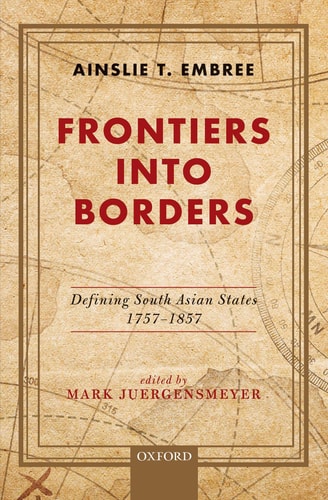
Frontiers into Borders: Defining South Asian States, 1757-1857
0
0
As an Amazon Associate and affiliate partner, Menrva Books earns from qualifying purchases. Learn more
Author Description
Following the death of the great historian, Ainslie T. Embree, this remarkable document was found in his study, a project to which he had devoted the last years of his life. It is an insightful exploration of how the boundaries of the modern South Asian states were created in the late 18th and early 19th centuries, based on a careful examination of original materials in archives in England and India. Artfully written with rich local detail, this book reveals the fascinating interplay of colonial and local interests as the modern states were carved into being. It is destined to be a classic in the history of South Asian nation building.
Menrva's Summary
THE THESIS
How did the colonial administration and local power structures interact to define the territorial boundaries of modern South Asian states between 1757 and 1857? Late Professor Ainslie T. Embree, a distinguished scholar of South Asian history, utilizes primary source materials from both English and Indian archives to reconstruct the geopolitical formation of the region. The text argues that the current borders are not merely colonial impositions but the result of a complex, ongoing negotiation between imperial ambitions and indigenous political realities.
THE SCOPE MAP
What You Will Find
- Analysis of archival records from the East India Company era.
- Examination of the transition from fluid frontiers to fixed state borders.
- Case studies on the interplay between colonial governance and local power dynamics.
Scope Limits
- The analysis is strictly confined to the period between 1757 and 1857.
- The text does not cover the post-colonial partition of 1947 or modern border disputes.
THE AUTHORITY PERSPECTIVE
Historians recognize this work as a significant contribution to the study of colonial state formation, noting the depth of Embree's archival research. The prose is considered accessible yet academically rigorous, making it a valuable resource for students and scholars of South Asian political history.
Page Count:
220
Publication Date:
2020-05-05
Publisher:
Oxford University Press
ISBN-10:
0190121068
ISBN-13:
9780190121068
History
Asia history
19th Century
Asian History
Nation-building
Colonialism
18th century
Community Tags
Similar Books