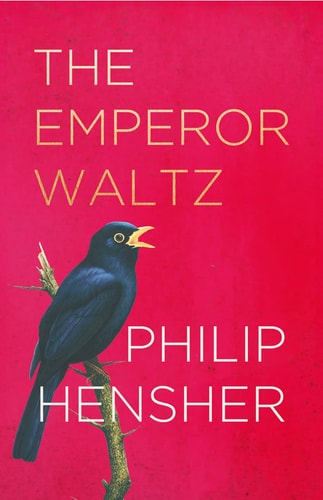
The Emperor Waltz
0
0
As an Amazon Associate and affiliate partner, Menrva Books earns from qualifying purchases. Learn more
Author Description
The new novel from Booker Prize-shortlisted Philip Hensher is his most ambitious and daring novel yet.In a third-century desert settlement on the fringes of the Roman Empire, a new wife becomes fascinated by a cult that is persecuted by the Emperor Diocletian. In 1922, Christian, a young artist, travels to Weimar to begin his studies at the Bauhaus, where the avant-garde confronts conservative elements around it. With postwar Germany in turmoil, while the Bauhaus attempts to explore radical ways of thinking and living, Christian finds that love will change him for ever. And in 1970s London Duncan uses his inheritance to establish the country’s first gay bookshop in the face of opposition from the neighbours and victimisation by the police.Delving deep into the human spirit to explore connections between love, sanctity, commitment and virtue, Philip Hensher takes as his subject small groups of men and women, tightly bound together, trying to change the world through the example of their lives. The Emperor Waltz is an absorbing echo-chamber of a novel, innovative and compelling, that explores what it means for us to belong to each other.
Menrva's Summary
THE PULSE
Across three distinct historical eras, disparate groups of individuals struggle to maintain their convictions and identities against the encroaching pressures of state-sanctioned intolerance and societal upheaval. In a third-century Roman desert settlement, a woman finds herself drawn to a persecuted religious sect; in 1922 Weimar Germany, a young artist at the Bauhaus navigates the collision of radical creative expression and conservative backlash; and in 1970s London, a man faces systemic harassment while establishing a pioneering gay bookstore. The narrative framework utilizes a triptych structure, weaving these chronologically separated threads to examine the enduring nature of human commitment and the cost of living according to one's principles. Each protagonist operates within rigid physical and social constraints, forced to choose between personal safety and the pursuit of a meaningful, communal existence.
INSIDE THE PAGES
- Multi-period narrative structure spanning from the Roman Empire to the twentieth century
- Exploration of the intersection between artistic movements and political instability
- Focus on the formation and survival of marginalized communities
- Examination of the historical evolution of religious and social persecution
- Detailed depiction of the Bauhaus school's cultural environment in 1920s Germany
- Analysis of the challenges faced by early LGBTQ+ activists in 1970s London
- Thematic focus on the nature of sanctity and virtue in secular and religious contexts
- Interconnected character arcs that emphasize the continuity of human experience across time
THE COLLECTIVE ECHO
This work is characterized by its ambitious structural design, which attempts to bridge vast temporal gaps through thematic resonance rather than direct plot causality. The prose reflects a meticulous attention to historical detail, particularly in the rendering of the Bauhaus era and the atmospheric tension of the Roman frontier. The narrative suggests a preoccupation with the mechanics of resistance, focusing on how small, isolated groups maintain their integrity in the face of larger, hostile systems. By juxtaposing these three distinct settings, the novel invites an analytical comparison of how the definition of virtue shifts and persists across different societal frameworks.
Page Count:
624
Publication Date:
2014-07-03
Publisher:
Fourth Estate
ISBN-10:
0007459572
ISBN-13:
9780007459575
Historical Fiction
Romance
Literary Fiction
Art History
Contemporary
Roman Empire
Subjects
Community Tags
Similar Books