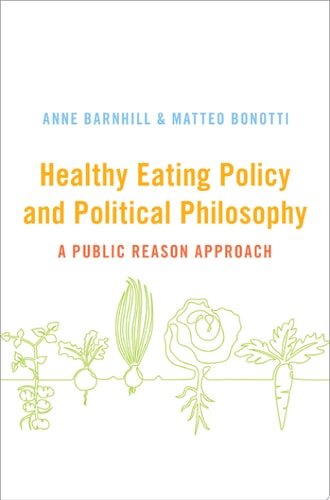
Healthy Eating Policy and Political Philosophy: A Public Reason Approach
0
0
As an Amazon Associate and affiliate partner, Menrva Books earns from qualifying purchases. Learn more
Author Description
Who gets to decide what it means to live a healthy lifestyle, and how important a healthy lifestyle is to a good life? As more governments make preventing obesity and diet-related illness a priority, it's become more important to consider the ethics and acceptability of their efforts. When it comes to laws and policies that promote healthy eating--such as special taxes on sugary drinks and the banning of food deemed unhealthy--critics argue that these policies are paternalistic, and that they limit individual autonomy over food choices. In Healthy Eating Policy and Political Philosophy: A Public Reason Approach, Anne Barnhill and Matteo Bonotti show that both paternalistic justifications for healthy eating efforts and anti-paternalistic arguments against them can be grounded in perfectionist views that overly prioritize some values over others. The authors therefore propose a more inclusive, public reason approach to healthy eating policy that will be appealing to those who take pluralism and cultural diversity seriously, by providing a framework through which different kinds of values, including but not limited to autonomy and health, can be factored into the public justification for healthy eating efforts. Additionally, the book adopts a 'farm to fork' approach to the ethics of healthy eating efforts: it engages with theories and debates in political philosophy, considers the implications of different theoretical positions for healthy eating efforts, and then develops a concrete tool for assessing policies that will be of interest to both scholars and policymakers. As well as offering a novel normative analysis of healthy eating policy, the authors offer a new theoretical framework that will be applicable to a wide range of public policy scenarios.
Menrva's Summary
THE THESIS
This book investigates the ethical legitimacy of government-led healthy eating policies by applying a public reason framework to resolve the tension between paternalistic intervention and individual autonomy. Anne Barnhill and Matteo Bonotti, both scholars in political philosophy and ethics, analyze the intersection of state health initiatives and democratic values. They argue that existing debates often rely on perfectionist assumptions and propose a more inclusive methodology that balances health outcomes with pluralistic societal values.
THE SCOPE MAP
What You Will Find
- A normative analysis of healthy eating policies such as sugar taxes and food bans.
- A public reason framework for evaluating public health interventions.
- A 'farm to fork' approach that connects abstract political theory to concrete policy assessment.
Scope Limits
- The text does not provide empirical data on the clinical effectiveness of specific dietary interventions.
- It does not offer a comprehensive history of global obesity policy.
THE AUTHORITY PERSPECTIVE
Scholars in political philosophy and public policy view this work as a significant contribution to the literature on state paternalism and democratic justification. Experts highlight the text as a useful resource for policymakers seeking to navigate the ethical complexities of public health regulation.
Page Count:
259
Publication Date:
2021-01-01
Publisher:
Oxford University Press
ISBN-10:
0190937904
ISBN-13:
9780190937904
Philosophy
Political Philosophy
Sociology of Health
Public Health
Ethics
Public Policy
Medical
Allied Health
Community Tags
Similar Books