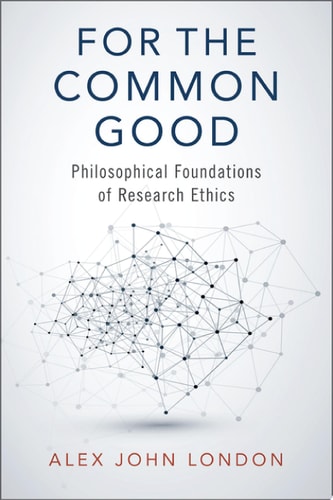
For the Common Good: Philosophical Foundations of Research Ethics
0
0
As an Amazon Associate and affiliate partner, Menrva Books earns from qualifying purchases. Learn more
Author Description
The foundations of research ethics are riven with fault lines emanating from a fear that if research is too closely connected to weighty social purposes an imperative to advance the common good through research will justify abrogating the rights and welfare of study participants. The result is an impoverished conception of the nature of research, an incomplete focus on actors who bear important moral responsibilities, and a system of ethics and oversight highly attuned to the dangers of research but largely silent about threats of ineffective, inefficient, and inequitable medical practices and health systems. In For the Common Good: Philosophical Foundations of Research Ethics, Alex John London defends a conception of the common good that grounds a moral imperative with two requirements. The first is to promote research that generates the information necessary to enable key social institutions to effectively, efficiently, and equitably safeguard the basic interests of individuals. The second is to ensure that research is organized as a voluntary scheme of social cooperation that respects its various contributors' moral claims to be treated as free and equal. Connecting research to the goals of a just social order grounds a framework for assessing and managing research risk that reconciles these requirements and justifies key oversight practices in non-paternalistic terms. Reconceiving research ethics as resolving coordination problems and providing credible assurance that these requirements are being met expands the issues and actors that fall within the purview of the field and provides the foundation for a more unified and coherent approach to domestic and international research. This is an open access title available under the terms of a CC BY-NC-ND 4.0 license. It is free to read at Oxford Scholarship Online and offered as a free PDF download from OUP and selected open access locations.
Menrva's Summary
THE THESIS
This book investigates how research ethics can be re-conceptualized to balance the protection of individual participants with the moral imperative to advance the common good. Alex John London, a prominent scholar in bioethics and philosophy, utilizes a framework of social cooperation to argue that research should be viewed as a vital component of a just social order. He critiques the current oversight systems for being overly focused on risk mitigation at the expense of addressing systemic inefficiencies and inequities in health systems. By grounding research ethics in the requirements of a just society, London provides a unified approach to managing the moral responsibilities of researchers and institutions.
THE SCOPE MAP
What You Will Find
- A philosophical framework for reconciling individual participant rights with collective social benefits.
- An analysis of research as a voluntary scheme of social cooperation.
- A critique of current oversight practices that prioritize risk avoidance over the promotion of equitable health systems.
- Methodologies for assessing research risk in non-paternalistic terms.
THE AUTHORITY PERSPECTIVE
Experts in the field of bioethics recognize this work as a significant contribution to the foundational literature on research oversight. Readers frequently note the academic density of the prose, which is intended for scholars, policymakers, and practitioners engaged in the ethics of clinical and social research.
Page Count:
475
Publication Date:
2021-01-01
Publisher:
Oxford University Press
ISBN-10:
0197534856
ISBN-13:
9780197534854
Philosophy
Ethics
Medical Ethics
Social Science
Research Ethics
Allied Health
Public Health
Medical
Medicine
Community Tags
Similar Books