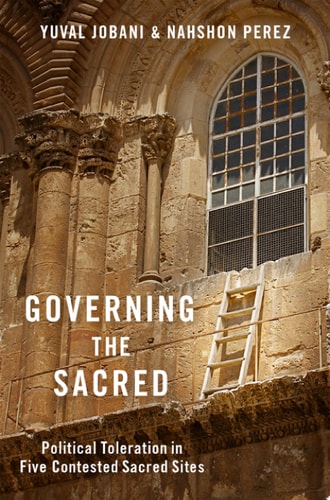
Governing the Sacred: Political Toleration in Five Contested Sacred Sites
0
0
As an Amazon Associate and affiliate partner, Menrva Books earns from qualifying purchases. Learn more
Author Description
Holy sites are often at the center of intense contestation between different groups regarding a wide variety of issues, including ownership, access, usage rights, permissible religious conduct, and many others. They are often the source of intractable long-standing conflicts and extreme violence.These difficulties are exemplified by the five sites profiled in Governing the Sacred: Devils Tower National Monument (Wyoming, US), Babri Masjid/Ram Janmabhoomi (Uttar-Pradesh, India), the Western Wall (Jerusalem), the Church of the Holy Sepulchre (Jerusalem), and the Temple Mount/Haram esh-Sharif (Jerusalem). Telling the fascinating stories of these high-profile contested sites, the authors develop and critically explore five different models of governing such sites: "non-interference," "separation and division," "preference," "status-quo," and "closure."Each model relies on different sets of considerations; central among them are trade-offs between religious liberty and social order. This novel typology aims to assist democratic governments in their attempt to secure public order and mutual toleration among opposed groups in contested sacred sites.
Menrva's Summary
THE THESIS
How can democratic governments effectively manage and resolve conflicts over sacred sites while balancing religious liberty with the necessity of maintaining social order? The authors, Yuval Jobani and Nahshon Perez, utilize a comparative political framework to analyze the governance of five high-profile contested locations. By examining the intersection of law, theology, and public policy, they propose a typology of management models designed to mitigate violence and foster coexistence in deeply divided societies.
THE SCOPE MAP
What You Will Find
- Detailed case studies of Devils Tower, Babri Masjid, the Western Wall, the Church of the Holy Sepulchre, and the Temple Mount.
- A structured typology of governance models including non-interference, separation, preference, status-quo, and closure.
- An analysis of the trade-offs between individual religious rights and collective public security.
Scope Limits
- The study focuses primarily on democratic governance frameworks and does not extensively cover non-democratic or authoritarian management strategies.
- The analysis is limited to the five specific sites mentioned and does not attempt a global survey of all contested religious spaces.
THE AUTHORITY PERSPECTIVE
Scholars in the field of political theology and conflict resolution identify this work as a significant contribution to the study of religious site management. Readers frequently note the clarity of the authors' typology and the practical applicability of their framework for policymakers dealing with complex sectarian disputes.
Page Count:
216
Publication Date:
2020-05-01
Publisher:
Oxford University Press
ISBN-10:
0190932384
ISBN-13:
9780190932381
Religion and sociology
Conflict Resolution
Human rights
Sociology of Religion
Religion and Politics
Community Tags
Similar Books