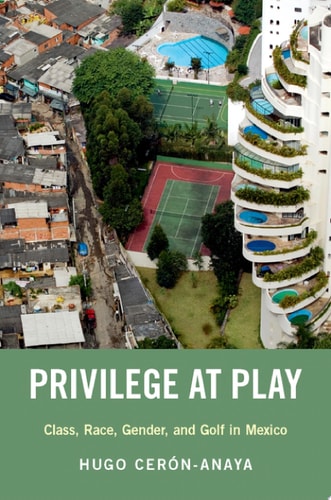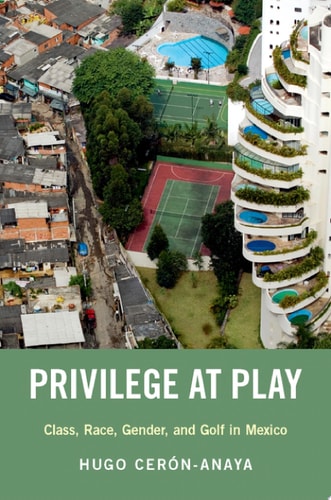
Privilege at Play: Class, Race, Gender, and Golf in Mexico
0
0
As an Amazon Associate and affiliate partner, Menrva Books earns from qualifying purchases. Learn more
Author Description
While most research on inequality focuses on impoverished communities, it often ignores how powerful communities and elites monopolize resources at the top of the social hierarchy. In Privilege at Play, Hugo Ceron-Anaya offers an intersectional analysis of Mexican elites to examine the ways affluent groups perpetuate dynamics of domination and subordination. Using ethnographic research conducted inside three exclusive golf clubs and in-depth interviews with upper-middle and upper-class golfers, as well as working-class employees, Ceron-Anaya focuses on the class, racial, and gender dynamics that underpin privilege in contemporary Mexico. His detailed analysis of social life and the organization of physical space further considers how the legacy of imperialism continues to determine practices of exclusion and how social hierarchies are subtlety reproduced through distinctions such as fashion and humor, in addition to the traditional indicators of wealth and class. Adding another dimension to the complex nature of social exclusion, Privilege at Play shows how elite social relations and spaces allow for the resource hoarding and monopolization that helps create and maintain poverty.
Menrva's Summary
THE THESIS
This book investigates how elite social spaces and practices in Mexico facilitate the reproduction of social hierarchies and the monopolization of resources. Hugo Cerón-Anaya, a sociologist specializing in social inequality, utilizes ethnographic fieldwork conducted within three exclusive golf clubs to analyze the intersection of class, race, and gender. By examining the interactions between affluent members and working-class employees, the author argues that privilege is actively maintained through subtle cultural markers and the strategic organization of physical space.
THE SCOPE MAP
What You Will Find
- Ethnographic observations of social life within three exclusive Mexican golf clubs.
- In-depth interview data from both upper-class members and working-class service staff.
- Analysis of cultural distinctions including fashion, humor, and spatial organization.
- Theoretical framework connecting historical imperialism to contemporary practices of exclusion.
Scope Limits
- The study is geographically confined to specific elite spaces in Mexico and does not provide a comprehensive analysis of all Mexican social strata.
- The research focuses primarily on the golf club environment rather than broader national economic policy.
THE AUTHORITY PERSPECTIVE
Scholars in the field of sociology and Latin American studies identify this work as a significant contribution to the study of elite power dynamics. Readers frequently note the academic rigor of the ethnographic approach and the clarity with which the author connects micro-level social interactions to macro-level structures of inequality.
Page Count:
231
Publication Date:
2019-01-01
Publisher:
Oxford University Press
ISBN-10:
0190931639
ISBN-13:
9780190931636
Sociology
American Studies
Anthropology
Class Studies
Cultural Anthropology
Ethnic Studies
Ethnography