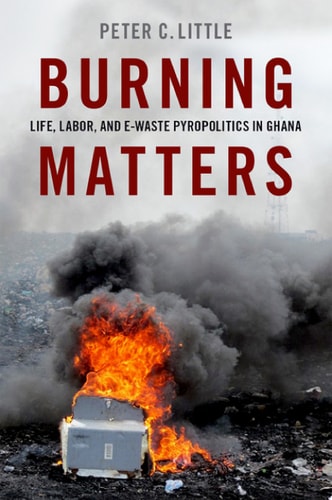
Burning Matters: Life, Labor, and E-Waste Pyropolitics in Ghana
0
0
As an Amazon Associate and affiliate partner, Menrva Books earns from qualifying purchases. Learn more
Author Description
Global trade in electronic waste (e-waste) has led to various waste management challenges and many regions of the Global South have suffered the toxic consequences. In Burning Matters, Peter C. Little explores the complex cultural, economic, and environmental health politics of e-waste work in Ghana. He brings to light the lived experiences of Ghana's e-waste workers, as they navigate the health, social, and economic challenges of highly toxic e-waste labor. In particular, Little engages the experiences of e-waste workers who burn bundles of electrical cables to extract copper, a practice that contaminates bodies and the urban environment and which has attracted international organizations seeking to mitigate risk and find quick tech solutions to this highly toxic e-waste work. A nuanced perspective on e-waste burning and environmental politics in Africa at a time when global e-waste generation and trade is at an all-time high, Burning Matters contends that e-waste interventions devoid of ethnographic perspective and knowledge risk downplaying the vibrant complexities of e-waste itself and the matters of social life and labor that matter most to Ghana's e-waste workers.
Menrva's Summary
THE THESIS
How do the lived experiences of e-waste workers in Ghana challenge international, top-down interventions regarding toxic labor practices? Peter C. Little, an anthropologist specializing in environmental health and political ecology, utilizes extensive ethnographic fieldwork to examine the intersection of global trade, local labor, and environmental toxicity. He argues that technological solutions to e-waste management often fail because they ignore the complex social and economic realities of the individuals performing the work.
THE SCOPE MAP
What You Will Find
- Ethnographic analysis of e-waste labor practices in Ghana, specifically cable burning for copper extraction.
- Examination of the tension between international environmental policy and local survival strategies.
- Analysis of the health and social impacts of toxic exposure on urban populations.
Scope Limits
- The study focuses primarily on the Ghanaian context and does not provide a comprehensive global survey of all e-waste processing sites.
- The book does not offer a technical manual for waste management infrastructure or engineering solutions.
THE AUTHORITY PERSPECTIVE
Scholars in the fields of political ecology and medical anthropology recognize this work as a critical contribution to understanding the human cost of global waste streams. Readers frequently note the academic rigor of the ethnographic prose and its effectiveness in humanizing the subjects of international environmental policy debates.
Page Count:
245
Publication Date:
2021-01-01
Publisher:
Oxford University Press
ISBN-10:
0190934573
ISBN-13:
9780190934576
Philosophy
Anthropology
Sociology
Global Studies
Cultural Anthropology
Labor Studies
Ethnic Studies
Technology and Society
Community Tags
Other Editions(2)
Similar Books