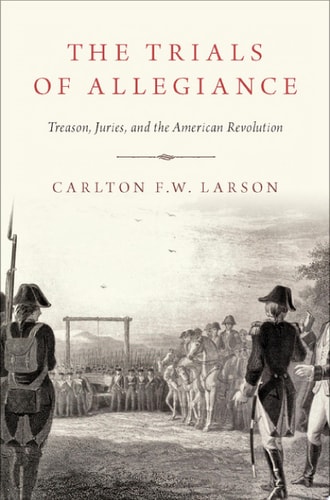
The Trials of Allegiance: Treason, Juries, and the American Revolution
0
0
As an Amazon Associate and affiliate partner, Menrva Books earns from qualifying purchases. Learn more
Author Description
The Trials of Allegiance examines the law of treason during the American Revolution: a convulsive, violent civil war in which nearly everyone could be considered a traitor, either to Great Britain or to America.Drawing from extensive archival research in Pennsylvania, one of the main centers of the revolution, Carlton Larson provides the most comprehensive analysis yet of the treason prosecutions brought by Americans against British adherents: through committees of safety, military tribunals, and ordinary criminal trials. Although popular rhetoric against traitors was pervasive in Pennsylvania, jurors consistently viewed treason defendants not as incorrigibly evil, but as fellow Americans who had made a political mistake. This book explains the repeated and violently controversial pattern of acquittals. Juries were carefully selected in ways that benefited the defendants, and jurors refused to accept the death penalty as an appropriate punishment for treason. The American Revolution, unlike many others, would not be enforced with the gallows.More broadly, Larson explores how the Revolution's treason trials shaped American national identity and perceptions of national allegiance. He concludes with the adoption of the Treason Clause of the United States Constitution, which was immediately put to use in the early 1790s in response to the Whiskey Rebellion and Fries's Rebellion.In taking a fresh look at these formative events, The Trials of Allegiance reframes how we think about treason in American history, up to and including the present.
Menrva's Summary
THE THESIS
This book investigates how the legal prosecution of treason during the American Revolution shaped the development of American national identity and the eventual constitutional definition of the crime. Carlton F.W. Larson, a professor of law, utilizes extensive archival research from Pennsylvania to analyze the intersection of revolutionary politics and the judicial system. He argues that the consistent pattern of acquittals in treason trials reflected a societal refusal to utilize the gallows as a tool of political enforcement, thereby influencing the drafting of the Treason Clause in the United States Constitution.
THE SCOPE MAP
What You Will Find
- Analysis of treason prosecutions through committees of safety, military tribunals, and criminal courts.
- Examination of jury selection processes and their impact on trial outcomes in Pennsylvania.
- Historical context regarding the Whiskey Rebellion and Fries's Rebellion.
Scope Limits
- The study focuses primarily on Pennsylvania as a case study rather than providing a comprehensive national survey of all thirteen colonies.
THE AUTHORITY PERSPECTIVE
Legal scholars and historians recognize this work as a significant contribution to the understanding of early American jurisprudence and the practical application of revolutionary law. Readers frequently note the academic rigor of the research and the clarity with which the author connects colonial-era legal precedents to the formation of the U.S. Constitution.
Page Count:
424
Publication Date:
2019-01-01
Publisher:
Oxford University Press
ISBN-10:
0190932767
ISBN-13:
9780190932763
History
Law
Treason
American Revolution
American History
Legal History
History of the Americas
Professional Career & Trade
Trials
Community Tags
Similar Books