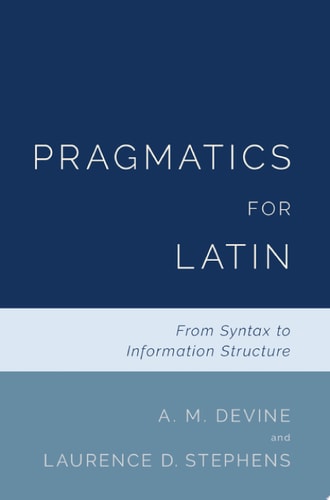
Pragmatics for Latin: From Syntax to Information Structure
0
0
As an Amazon Associate and affiliate partner, Menrva Books earns from qualifying purchases. Learn more
Author Description
Latin is often described as a free word order language, but in general each word order encodes a particular information structure: in that sense, each word order has a different meaning. Pragmatics for Latin provides a descriptive analysis of Latin information structure based on detailed philological evidence and elaborates a syntax-pragmatics interface that formalizes the informational content of the various different word orders. Using a slightly adjusted version of the structured meanings theory, the book shows how the pragmatic meanings matching the different word orders arise naturally and spontaneously out of the compositional process as an integral part of a single semantic derivation covering denotational and informational meaning at one and the same time.
Menrva's Summary
THE THESIS
This book investigates the relationship between Latin word order and information structure, arguing that word order is not free but encodes specific pragmatic meanings. The authors, A. M. Devine and Laurence D. Stephens, utilize extensive philological evidence to construct a formal syntax-pragmatics interface. By applying a modified version of structured meanings theory, they demonstrate how informational content is derived compositionally alongside denotational meaning within a unified semantic framework.
THE SCOPE MAP
What You Will Find
- Analysis of Latin word order patterns and their pragmatic functions
- A formal syntax-pragmatics interface model
- Application of structured meanings theory to classical Latin
- Detailed philological evidence and linguistic data
Scope Limits
- Does not provide a general introductory grammar of Latin
- Does not cover diachronic changes in Latin syntax beyond the scope of the proposed model
THE AUTHORITY PERSPECTIVE
Scholars and linguists recognize this work as a rigorous contribution to the study of Latin syntax and information structure. Readers frequently note the technical density of the prose, which is intended for those with a strong background in both classical philology and formal linguistic theory.
Page Count:
247
Publication Date:
2019-01-01
Publisher:
Oxford University Press
ISBN-10:
0190939494
ISBN-13:
9780190939496
Linguistics
Latin Language
Syntax
Latin
Pragmatics
World Languages
Philology
Community Tags
Similar Books