Indefinites Between Latin and Romance
0
0
As an Amazon Associate and affiliate partner, Menrva Books earns from qualifying purchases. Learn more
Author Description
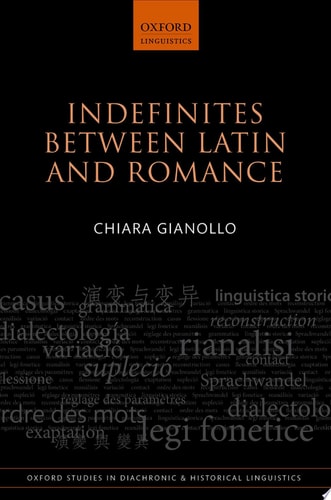
This book investigates the syntactic and semantic development of a selection of indefinite pronouns and determiners (such as aliquis 'some', nullus 'no', and nemo 'no one') between Latin and the Romance languages. Although these elements have undergone significant diachronic change since the Classical Latin period, the modern Romance languages show a remarkable degree of similarity in the way their systems of indefinites have evolved and are structured today. In this volume, Chiara Gianollo draws on data from Classical and Late Latin texts, and from electronic corpora of the early stages of various Romance languages, to propose a new account of these similarities. The focus is primarily on Late Latin: at this stage, the grammar of indefinites already shows a number of changes, which are homogeneously transmitted to the daughter languages, leading to parallelism in the various emerging Romance systems. The volume demonstrates the value of using methods and models from synchronic theoretical linguistics for investigating diachronic phenomena, as well as the importance of diachronic research in understanding the nature of crosslinguistic variation and language change.
Menrva's Summary
THE THESIS
This book investigates the syntactic and semantic evolution of indefinite pronouns and determiners as they transitioned from Classical Latin into the modern Romance language family. Chiara Gianollo, a specialist in theoretical and historical linguistics, utilizes a rigorous framework to analyze how specific indefinite forms like 'aliquis' and 'nemo' shifted over time. By examining data from Classical and Late Latin texts alongside early Romance corpora, the author argues that the structural changes observed in Late Latin provided a consistent foundation for the parallel developments seen in contemporary Romance systems.
THE SCOPE MAP
What You Will Find
- Analysis of indefinite pronouns and determiners including 'aliquis', 'nullus', and 'nemo'
- Comparative study of Classical Latin, Late Latin, and early Romance language corpora
- Application of synchronic theoretical linguistic models to diachronic language change
- Examination of crosslinguistic variation and grammatical transmission
Scope Limits
- The study focuses primarily on the transition period of Late Latin rather than the full history of every modern Romance dialect
- The research prioritizes syntactic and semantic development over phonological or morphological shifts
THE AUTHORITY PERSPECTIVE
Experts in the field recognize this work as a significant contribution to the study of diachronic syntax and the evolution of Romance grammar. Readers frequently note the academic density of the prose and the author's precise application of theoretical models to historical data.
Page Count:
0
Publication Date:
2018-01-01
Publisher:
Oxford University Press
ISBN-10:
0191850446
ISBN-13:
9780191850448
Semantics
Latin
Linguistics
Syntax
Historical linguistics
Community Tags
Other Editions(3)
Similar Books