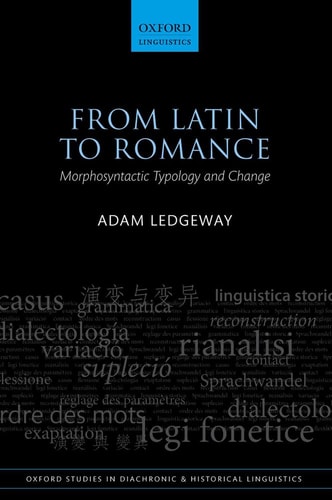
From Latin to Romance: Morphosyntactic Typology and Change
0
0
As an Amazon Associate and affiliate partner, Menrva Books earns from qualifying purchases. Learn more
Author Description
This book examines the grammatical changes that took place in the transition from Latin to the Romance languages. The emerging language underwent changes in three fundamental areas involving the noun phrase, verb phrase, and the sentence. The impact of the changes can be seen in the reduction of the Latin case system; the appearance of auxiliary verb structures to mark such categories tense, mood, and voice; and a shift towards greater rigidification of word order. The author considers how far these changes are interrelated and compares their various manifestations and pace of change across the different standard and non-standard varieties of Romance. He describes the historical background to the emergence of the Romance varieties and their Latin ancestry, considering in detail the richly documented diachronic variation exhibited by the Romance family.Adam Ledgeway reviews the accounts and explanations that have been proposed within competing theoretical frameworks, and considers how far traditional ideas should be reinterpreted in light of recent theoretical developments. His wide-ranging account shows that the transition from Latin to Romance is not only of great intrinsic interest, but both provides a means of challenging linguistic orthodoxies and presents opportunities to shape new perspectives on language change, structure, and variation. His fascinating book will appeal equally to Romance linguists, Latinists, philologists, historical linguists, and syntacticians of all theoretical persuasions.
Menrva's Summary
THE THESIS
This book investigates the morphosyntactic evolution from Latin to the Romance languages, questioning how specific grammatical shifts occurred and whether these changes were interrelated. Adam Ledgeway, a specialist in Romance linguistics, utilizes a comparative diachronic approach to analyze the transition of grammatical structures. He evaluates competing theoretical frameworks to explain the reduction of the Latin case system, the rise of auxiliary verbs, and the rigidification of word order across various Romance varieties. By synthesizing historical data with modern syntactic theory, the author provides a comprehensive account of how these languages diverged from their common ancestor.
THE SCOPE MAP
What You Will Find
- Analysis of noun phrase, verb phrase, and sentence-level grammatical shifts.
- Comparative study of standard and non-standard Romance language varieties.
- Evaluation of traditional philological accounts against contemporary theoretical developments.
- Examination of the historical background and Latin ancestry of the Romance family.
THE AUTHORITY PERSPECTIVE
Experts recognize this work as a significant contribution to the field of diachronic linguistics, particularly for its rigorous application of syntactic theory to historical data. Readers frequently note the academic density of the prose, making it a primary resource for advanced students and researchers in Romance philology.
Page Count:
464
Publication Date:
2015-08-01
Publisher:
Oxford University Press
ISBN-10:
019873669X
ISBN-13:
9780198736691
Historical linguistics
Philology
Latin
Linguistics
Syntax
Community Tags
Similar Books