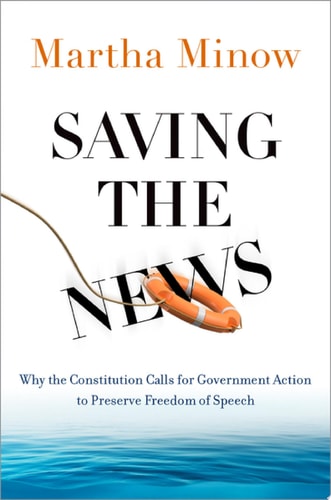
Saving the News: Why the Constitution Calls for Government Action to Preserve Freedom of Speech
0
0
As an Amazon Associate and affiliate partner, Menrva Books earns from qualifying purchases. Learn more
Author Description
A detailed argument of how our government has interfered in the direction of America's media landscape that traces major transformations in media since the printing press and charts a path for reform. In Saving the News, Martha Minow takes stock of the new media landscape. She focuses on the extent to which our constitutional system is to blame for the current parlous state of affairs and on our government's responsibilities for alleviating the problem. As Minow shows, the First Amendment of the US Constitution assumes the existence and durability of a private industry. Although the First Amendment does not govern the conduct of entirely private enterprises, nothing in the Constitution forecloses government action to regulate concentrated economic power, to require disclosure of who is financing communications, or to support news initiatives where there are market failures. Moreover, the federal government has contributed financial resources, laws, and regulations to develop and shape media in the United States. Thus, Minow argues that the transformation of media from printing presses to the internet was shaped by deliberate government policies that influenced the direction of private enterprise. In short, the government has crafted the direction and contours of America's media ecosystem.Building upon this basic argument, Minow outlines an array of reforms, including a new fairness doctrine, regulating digital platforms as public utilities, using antitrust authority to regulate the media, policing fraud, and more robust funding of public media. As she stresses, such reforms are not merely plausible ideas; they are the kinds of initiatives needed if the First Amendment guarantee of freedom of the press continues to hold meaning in the twenty-first century.
Menrva's Summary
THE THESIS
Does the United States government possess the constitutional authority and the responsibility to intervene in the modern media landscape to preserve the integrity of the press? Martha Minow, a distinguished legal scholar and former dean of Harvard Law School, examines the historical role of government policy in shaping the American media ecosystem. She argues that the First Amendment does not preclude, but rather necessitates, proactive government measures to address market failures, concentrated economic power, and the erosion of public-interest journalism in the digital age.
THE SCOPE MAP
What You Will Find
- Historical analysis of media evolution from the printing press to the internet
- Legal framework for regulating digital platforms as public utilities
- Proposed policy reforms including a modern fairness doctrine and antitrust applications
- Examination of government financial and regulatory influence on media development
Scope Limits
- Does not provide a technical manual for digital platform architecture
- Does not offer a comprehensive history of global media outside the United States
THE AUTHORITY PERSPECTIVE
Legal scholars and media critics frequently cite this work as a significant contribution to the debate over the intersection of constitutional law and digital-age media regulation. Readers often note the academic rigor of the prose, which balances historical context with specific, actionable policy recommendations for contemporary governance.
Page Count:
251
Publication Date:
2021-01-01
Publisher:
Oxford University Press
ISBN-10:
0190948434
ISBN-13:
9780190948436
Constitutions
Professional Career & Trade
Public Policy
United States
Media Studies
Journalism
Constitutional Law
Law
Community Tags
Similar Books