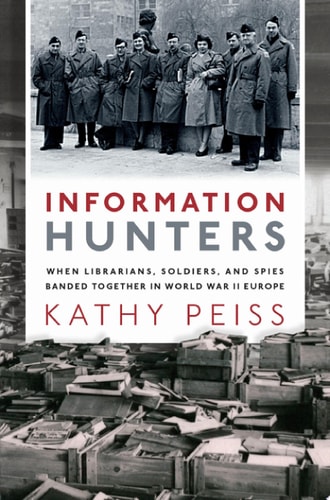
Information Hunters: When Librarians, Soldiers, and Spies Banded Together in World War II Europe
0
0
As an Amazon Associate and affiliate partner, Menrva Books earns from qualifying purchases. Learn more
Author Description
While armies have seized enemy records and rare texts as booty throughout history, it was only during World War II that an unlikely band of librarians, archivists, and scholars traveled abroad to collect books and documents to aid the military cause. Galvanized by the events of war into acquiring and preserving the written word, as well as providing critical information for intelligence purposes, these American civilians set off on missions to gather foreign publications and information across Europe. They journeyed to neutral cities in search of enemy texts, followed a step behind advancing armies to capture records, and seized Nazi works from bookstores and schools. When the war ended, they found looted collections hidden in cellars and caves. Their mission was to document, exploit, preserve, and restitute these works, and even, in the case of Nazi literature, to destroy them. In this fascinating account, cultural historian Kathy Peiss reveals how book and document collecting became part of the new apparatus of intelligence and national security, military planning, and postwar reconstruction. Focusing on the ordinary Americans who carried out these missions, she shows how they made decisions on the ground to acquire sources that would be useful in the war zone as well as on the home front. These collecting missions also boosted the postwar ambitions of American research libraries, offering a chance for them to become great international repositories of scientific reports, literature, and historical sources. Not only did their wartime work have lasting implications for academic institutions, foreign-policy making, and national security, it also led to the development of today's essential information science tools. Illuminating the growing global power of the United States in the realms of intelligence and cultural heritage, Peiss tells the story of the men and women who went to Europe to collect and protect books and information and in doing so enriches the debates
Menrva's Summary
THE THESIS
How did the mobilization of librarians, archivists, and scholars during World War II transform the collection of information into a critical component of military intelligence and national security? Kathy Lee Peiss, a cultural historian, examines the intersection of wartime exigency and information management. By analyzing the activities of American civilians tasked with acquiring foreign publications and enemy records, she argues that these missions were foundational to modern intelligence apparatuses and the expansion of American research libraries.
THE SCOPE MAP
What You Will Find
- Historical analysis of Allied intelligence gathering through the acquisition of enemy texts and records.
- Documentation of the transition from wartime information collection to postwar academic repository development.
- Case studies of individual librarians and scholars operating in neutral cities and active war zones.
Scope Limits
- The text focuses primarily on American efforts and does not provide an exhaustive account of all Allied nations' intelligence-gathering operations.
- It does not cover the entirety of the war's military strategy, focusing specifically on the cultural and informational aspects of the conflict.
THE AUTHORITY PERSPECTIVE
Historians and information science scholars frequently cite this work for its detailed archival research into the intersection of intelligence and cultural heritage. Readers often note the academic density of the prose, which provides a thorough examination of the administrative and logistical challenges faced by these wartime information hunters.
Page Count:
291
Publication Date:
2019-01-01
Publisher:
Oxford University Press
ISBN-10:
0190944633
ISBN-13:
9780190944636
History
Religion
Cultural History
Confiscations
Cultural property protection
World War
Destruction and pillage
Judaism
United States
Library of Congress
Books
Military History
Librarians
Intelligence
Books history
Community Tags
Similar Books