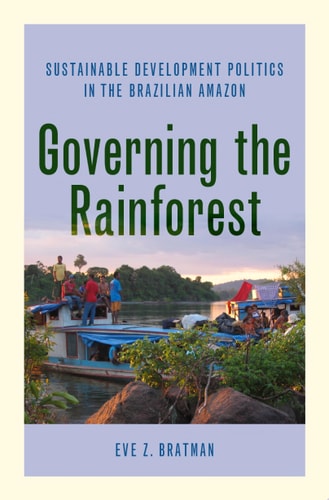
Governing the Rainforest: Sustainable Development Politics in the Brazilian Amazon
0
0
As an Amazon Associate and affiliate partner, Menrva Books earns from qualifying purchases. Learn more
Author Description
Sustainable development is often thought of as a product that can be obtained by following a prescribed course of interventions. Rather than conceptualizing it as a sweet spot of economic, ecological, and social balance, sustainable development is an ongoing process of embroilments requiring constant negotiation of often-competing aims. Sustainable development politics yield highly uneven results among different members of society and different geographic areas. As this book argues, such imbalances mean that sustainable development processes often prioritize economic over environmental goals, perpetuating and reinforcing economic and political inequalities. Governing the Rainforest looks at development and conservation efforts in the Brazilian Amazon, where the government and corporate interests bump up against those of environmentalists and local populations. This book asks why sustainable development continues to be such a powerful and influential idea in the region, and what impact it has had on various political and economic interests and geographic areas. In other words, as Eve Z. Bratman argues, sustainable development is a political practice in itself. This book offers detailed case study analysis, including of the creation of vast conservation corridors, the construction of one of the largest hydroelectric plants in the world, and new forms of land settlement projects. Based on a decade of Bratman's ethnographic fieldwork throughout Brazil, and particularly along the Trans-Amazonian Highway, Governing the Rainforest offers a fresh take on sustainable development within a multi-level analysis of actors, discourses, and practices.
Menrva's Summary
THE THESIS
This book investigates why sustainable development remains a dominant, influential political framework in the Brazilian Amazon despite its tendency to produce uneven social and environmental outcomes. Author Eve Z. Bratman, drawing on a decade of ethnographic fieldwork, argues that sustainable development is not a static goal but a continuous, contentious political practice. By examining the interplay between government policy, corporate interests, and local populations, the text demonstrates how these processes frequently prioritize economic expansion over ecological preservation, thereby reinforcing existing power imbalances.
THE SCOPE MAP
What You Will Find
- Analysis of large-scale infrastructure projects including hydroelectric plants and conservation corridors.
- Examination of land settlement projects along the Trans-Amazonian Highway.
- Multi-level analysis of political actors, institutional discourses, and local practices.
Scope Limits
- The study focuses specifically on the Brazilian Amazon and does not provide a global comparative analysis of sustainable development policies.
- The text prioritizes political and social outcomes over purely technical or biological assessments of environmental health.
THE AUTHORITY PERSPECTIVE
Scholars and practitioners in the field of environmental politics recognize this work as a rigorous ethnographic contribution to the study of Amazonian development. Readers frequently note the academic density of the prose, which provides a nuanced look at the friction between policy rhetoric and on-the-ground realities.
Page Count:
369
Publication Date:
2019-01-01
Publisher:
Oxford University Press
ISBN-10:
0190949406
ISBN-13:
9780190949402
Economic History
Brazil
Geography
American Studies
Public Policy
Community Tags
Similar Books