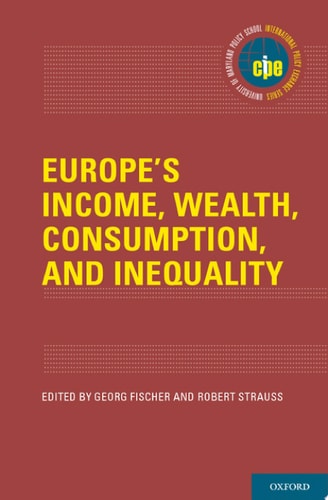
Europe's Income, Wealth, Consumption, and Inequality (International Policy Exchange)
0
0
As an Amazon Associate and affiliate partner, Menrva Books earns from qualifying purchases. Learn more
Author Description
European integration is focused on improving economic performance and increasing income levels in nations across the European Union. Political leaders and the media often use income trends to measure this progress, with inequality moving more and more to the forefront of these conversations. In this book, contributing authors focus on the economies within the EU, its member countries, and other European countries closely associated with the EU. The book includes an overview of economic and social trends, using long-term processes of European integration as a way to frame the discussions. Georg Fischer, Robert Strauss, and their contributors focus on explaining how policy makers and the media focus on national trends to measure progress among the nations in Europe. They make a specific point to look at the EU as an economic and political entity whose parts are closely interlinked rather than as a conglomerate of individual countries. The contributors consider the commonalities and differences between various institutions and policies, explaining how a decision in one country might impact another. Europe's Income, Wealth, Consumption, and Inequality offers a novel approach to the analysis of social and economic trends, and the resulting book identifies major policy challenges applicable in the EU and beyond.
Menrva's Summary
THE THESIS
This book investigates how economic indicators such as income, wealth, and consumption are utilized to measure the progress and integration of European nations. Authors Georg Fischer and Robert Strauss, alongside a team of contributors, analyze the EU as a singular, interlinked economic and political entity rather than a collection of isolated states. By examining long-term integration processes, the text provides a framework for understanding how national policy decisions create cross-border impacts and influence broader social trends.
THE SCOPE MAP
What You Will Find
- Comparative analysis of income and wealth distribution across EU member states.
- Examination of the interconnected nature of European economic and political institutions.
- Assessment of how media and political leaders interpret national economic data.
- Identification of major policy challenges resulting from European integration.
THE AUTHORITY PERSPECTIVE
Experts view this work as a useful resource for understanding the complexities of European economic integration and the limitations of national-level data. Readers frequently note the academic focus on policy-making and the systemic approach to analyzing the EU as a unified economic entity.
Page Count:
614
Publication Date:
2020-01-01
Publisher:
Oxford University Press
ISBN-10:
0197545726
ISBN-13:
9780197545720
Economics
European Union
Public Policy
Sociology
Economic systems
Social policy
Principles of Macroeconomics
Economic History
Community Tags
Similar Books