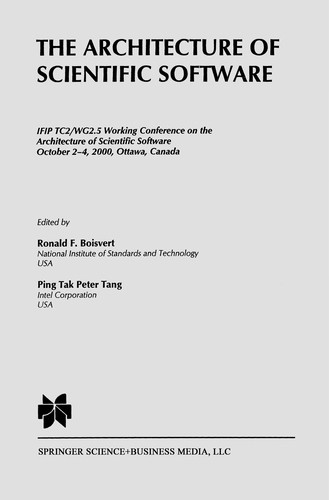
The Architecture of Scientific Software
0
0
As an Amazon Associate and affiliate partner, Menrva Books earns from qualifying purchases. Learn more
Author Description
Scientific applications involve very large computations that strain the resources of whatever computers are available. Such computations implement sophisticated mathematics, require deep scientific knowledge, depend on subtle interplay of different approximations, and may be subject to instabilities and sensitivity to external input. Software able to succeed in this domain invariably embeds significant domain knowledge that should be tapped for future use. Unfortunately, most existing scientific software is designed in an ad hoc way, resulting in monolithic codes understood by only a few developers. Software architecture refers to the way software is structured to promote objectives such as reusability, maintainability, extensibility, and feasibility of independent implementation. Such issues have become increasingly important in the scientific domain, as software gets larger and more complex, constructed by teams of people, and evolved over decades. In the context of scientific computation, the challenge facing mathematical software practitioners is to design, develop, and supply computational components which deliver these objectives when embedded in end-user application codes. The Architecture of Scientific Software addresses emerging methodologies and tools for the rational design of scientific software, including component integration frameworks, network-based computing, formal methods of abstraction, application programmer interface design, and the role of object-oriented languages. This book comprises the proceedings of the International Federation for Information Processing (IFIP) Conference on the Architecture of Scientific Software, which was held in Ottawa, Canada, in October 2000. It will prove invaluable reading for developers of scientific software, as well as for researchers in computational sciences and engineering.
Menrva's Summary
THE THESIS
This book investigates the challenges and emerging methodologies for designing and developing robust scientific software. The existing landscape of scientific software is often characterized by monolithic, ad hoc designs that are difficult to maintain and extend. This work addresses the critical need for software architecture in scientific computation, focusing on principles that promote reusability, maintainability, and extensibility. It explores how to embed domain knowledge effectively into computational components for end-user applications, particularly as software becomes larger, more complex, and team-developed over decades.
THE SCOPE MAP
- Emerging methodologies for rational scientific software design
- Component integration frameworks
- Network-based computing approaches
- Formal methods of abstraction
- Application programmer interface (API) design principles
- The role of object-oriented languages in scientific software
- Proceedings of the IFIP Conference on the Architecture of Scientific Software (Ottawa, Canada, October 2000)
THE AUTHORITY PERSPECTIVE
This collection of papers from the 2000 IFIP Conference on the Architecture of Scientific Software presents a snapshot of the field's concerns and advancements at the turn of the millennium. The content likely addresses the growing complexity of scientific applications and the need for structured approaches to software development. It would appeal to practitioners and researchers grappling with the challenges of building and maintaining large-scale scientific software systems.
Page Count:
358
Publication Date:
2001-01-01
ISBN-10:
1475767196
ISBN-13:
9781475767193
Science
Non-Fiction
Science & Technology
Software Engineering
Scientific Computing
Computer Science
Community Tags
Similar Books