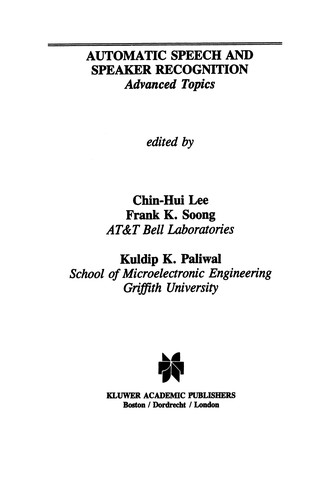
Automatic Speech and Speaker Recognition
0
0
As an Amazon Associate and affiliate partner, Menrva Books earns from qualifying purchases. Learn more
Author Description
Research in the field of automatic speech and speaker recognition has made a number of significant advances in the last two decades, influenced by advances in signal processing, algorithms, architectures, and hardware. These advances include: the adoption of a statistical pattern recognition paradigm; the use of the hidden Markov modeling framework to characterize both the spectral and the temporal variations in the speech signal; the use of a large set of speech utterance examples from a large population of speakers to train the hidden Markov models of some fundamental speech units; the organization of speech and language knowledge sources into a structural finite state network; and the use of dynamic, programming based heuristic search methods to find the best word sequence in the lexical network corresponding to the spoken utterance. Automatic Speech and Speaker Recognition: Advanced Topics groups together in a single volume a number of important topics on speech and speaker recognition, topics which are of fundamental importance, but not yet covered in detail in existing textbooks. Although no explicit partition is given, the book is divided into five parts: Chapters 1-2 are devoted to technology overviews; Chapters 3-12 discuss acoustic modeling of fundamental speech units and lexical modeling of words and pronunciations; Chapters 13-15 address the issues related to flexibility and robustness; Chapter 16-18 concern the theoretical and practical issues of search; Chapters 19-20 give two examples of algorithm and implementational aspects for recognition system realization. Audience: A reference book for speech researchers and graduate students interested in pursuing potential research on the topic. May also be used as a text for advanced courses on the subject.
Menrva's Summary
THE THESIS
This book investigates the significant advances in automatic speech and speaker recognition over the past two decades, driven by progress in signal processing, algorithms, architectures, and hardware. It details the adoption of statistical pattern recognition, the use of hidden Markov modeling for spectral and temporal variations, training models with large speech datasets, structuring speech and language knowledge into finite state networks, and employing dynamic programming for search methods. The book is structured into five parts, covering technology overviews, acoustic and lexical modeling, flexibility and robustness, search issues, and system realization.
THE SCOPE MAP
- Technology overviews of automatic speech and speaker recognition.
- Acoustic modeling of fundamental speech units.
- Lexical modeling of words and pronunciations.
- Issues related to flexibility and robustness in recognition systems.
- Theoretical and practical aspects of search algorithms.
- Algorithm and implementation details for recognition system realization.
THE AUTHORITY PERSPECTIVE
This work serves as a comprehensive reference for speech researchers and graduate students, offering in-depth coverage of topics fundamental to the field but not yet detailed in existing textbooks. The structure, divided into five parts, systematically progresses from foundational concepts to advanced implementation aspects. Its detailed exploration of statistical pattern recognition and hidden Markov modeling provides a solid grounding for those pursuing research or advanced study in automatic speech and speaker recognition.
Page Count:
536
Publication Date:
1996-01-01
ISBN-10:
1461285909
ISBN-13:
9781461285908
Science
Non-Fiction
Machine Learning
Speech Recognition
Computer Science
Community Tags
Similar Books