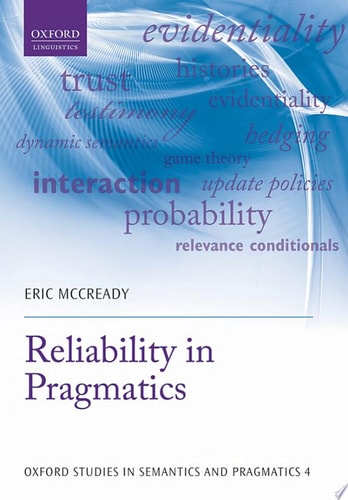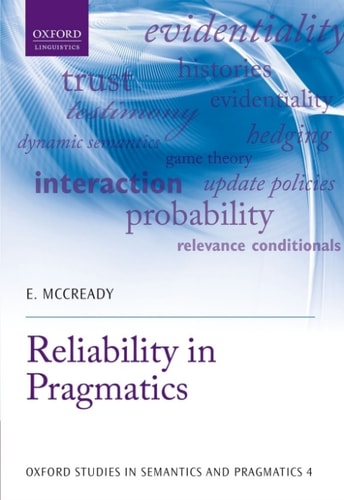
Reliability in Pragmatics
0
0
As an Amazon Associate and affiliate partner, Menrva Books earns from qualifying purchases. Learn more
Author Description
This book is an exploration of how knowledge about the reliability of information sources manifests itself in linguistic phenomena and use. It focuses on cooperation in language use and on how considerations of reliability influence what is done with the information acquired through language. Elin McCready provides a detailed account of the phenomena of hedging and evidentiality and analyses them using tools from game theory, dynamic semantics, and formal epistemology. Hedging is argued to be a mechanism used by speakers to protect their reputations for cooperativity from damage inflicted by infelicitous discourse moves. The pragmatics of evidential use is also discussed in terms of the histories of interaction that influence reputation: the author argues that past experience with the evidence source indexed by the evidential determines how the process of adding information will proceed. The book makes many new connections between seemingly disparate aspects of linguistic meaning and practice. It will be of interest to specialists in semantics, pragmatics, and philosophy of language, as well as those in the fields of philosophy and cognitive science with an interest in language and epistemology.
Menrva's Summary
THE THESIS
This book investigates how the perceived reliability of information sources influences linguistic phenomena, specifically hedging and evidentiality. Elin McCready, a specialist in formal semantics and pragmatics, utilizes a multidisciplinary framework to examine the intersection of language use and epistemic trust. By integrating game theory, dynamic semantics, and formal epistemology, the author argues that linguistic choices are strategic responses to the need for maintaining a reputation for cooperativity in discourse.
THE SCOPE MAP
What You Will Find
- Formal analysis of hedging as a mechanism for reputation management.
- Theoretical exploration of evidentiality based on interactional history.
- Application of game-theoretic models to discourse moves.
- Integration of dynamic semantics with epistemic reliability.
Scope Limits
- The text does not provide a general introduction to linguistics for non-specialists.
- It focuses primarily on formal and mathematical modeling rather than sociolinguistic or descriptive linguistic data.
THE AUTHORITY PERSPECTIVE
Experts in the field recognize this work as a rigorous contribution to the formal study of pragmatics and epistemic language. Readers frequently note the academic density of the prose, which assumes a strong background in formal semantics and game theory.
Page Count:
304
Publication Date:
2014-01-01
Publisher:
OUP Oxford
ISBN-10:
0191007404
ISBN-13:
9780191007408
English
Pragmatics
Semantics
Philosophy of
English & College Success
Epistemology
Linguistics