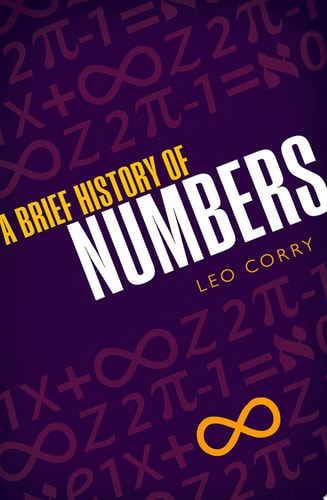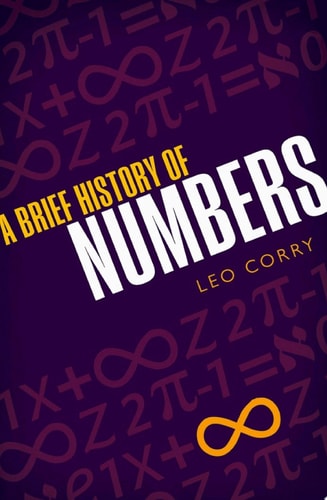
A Brief History of Numbers
0
0
As an Amazon Associate and affiliate partner, Menrva Books earns from qualifying purchases. Learn more
Author Description
The world around us is saturated with numbers. They are a fundamental pillar of our modern society, and accepted and used with hardly a second thought. But how did this state of affairs come to be? In this book, Leo Corry tells the story behind the idea of number from the early days of the Pythagoreans, up until the turn of the twentieth century. He presents an overview of how numbers were handled and conceived in classical Greek mathematics, in the mathematics of Islam, in European mathematics of the middle ages and the Renaissance, during the scientific revolution, all the way through to the mathematics of the 18th to the early 20th century. Focusing on both foundational debates and practical use numbers, and showing how the story of numbers is intimately linked to that of the idea of equation, this book provides a valuable insight to numbers for undergraduate students, teachers, engineers, professional mathematicians, and anyone with an interest in the history of mathematics.
Menrva's Summary
THE THESIS
How did the modern concept of number evolve from ancient philosophical origins to the rigorous mathematical frameworks of the twentieth century? Leo Corry, a historian of mathematics, examines the conceptual shifts in how numbers were defined, manipulated, and applied across diverse historical eras. By tracing the development of numerical theory alongside the evolution of algebraic equations, Corry provides a comprehensive overview of the intellectual labor required to establish our current mathematical foundations.
THE SCOPE MAP
What You Will Find
- Historical progression from Pythagorean thought through the Renaissance to the early 20th century.
- Analysis of the interplay between the concept of number and the development of equations.
- Examination of mathematical practices in classical Greek, Islamic, and European traditions.
Scope Limits
- The narrative concludes at the turn of the twentieth century and does not cover modern computational or post-modern mathematical developments.
- The text focuses primarily on the conceptual history of numbers rather than a technical manual for advanced mathematical proofs.
THE AUTHORITY PERSPECTIVE
Readers frequently note that the text serves as an accessible entry point for students and professionals interested in the historical context of their field. Experts highlight the book's ability to synthesize complex foundational debates into a coherent narrative suitable for a broad academic audience.
Page Count:
323
Publication Date:
2015-01-01
Publisher:
OUP Oxford
ISBN-10:
0191007072
ISBN-13:
9780191007071
Non-Fiction
Mathematics
Science History
Number Theory
Education
Mathematics - General
Mathematics Statistics
Mathematics history