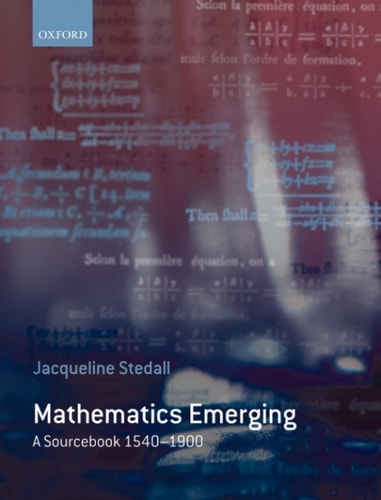
Mathematics Emerging: A Sourcebook 1540-1900
0
0
As an Amazon Associate and affiliate partner, Menrva Books earns from qualifying purchases. Learn more
Author Description
Aimed at students and researchers in Mathematics, History of Mathematics and Science, this book examines the development of mathematics from the late 16th Century to the end of the 19th Century. Mathematics has an amazingly long and rich history, it has been practised in every society and culture, with written records reaching back in some cases as far as four thousand years. This book will focus on just a small part of the story, in a sense the most recent chapter of it: the mathematics of western Europe from the sixteenth to the nineteenth centuries. Each chapter will focus on a particular topic and outline its history with the provision of facsimiles of primary source material along with explanatory notes and modern interpretations. Almost every source is given in its original form, not just in the language in which it was first written, but as far as practicable in the layout and typeface in which it was read by contemporaries.This book is designed to provide mathematics undergraduates with some historical background to the material that is now taught universally to students in their final years at school and the first years at college or university: the core subjects of calculus, analysis, and abstract algebra, along with others such as mechanics, probability, and number theory. All of these evolved into their present form in a relatively limited area of western Europe from the mid sixteenth century onwards, and it is there that we find the major writings that relate in a recognizable way to contemporary mathematics.
Menrva's Summary
THE THESIS
This sourcebook investigates the historical evolution of core mathematical concepts in Western Europe between 1540 and 1900. Jacqueline A. Stedall, a scholar in the history of mathematics, utilizes a collection of primary source documents to trace the development of subjects such as calculus, analysis, and abstract algebra. The text provides a framework for understanding how contemporary mathematical curricula emerged from specific historical writings and intellectual shifts during this period.
THE SCOPE MAP
What You Will Find
- Facsimiles of original primary source materials from the 16th to 19th centuries
- Explanatory notes and modern interpretations of historical mathematical texts
- Coverage of mechanics, probability, number theory, and analysis
Scope Limits
- The text is geographically restricted to Western Europe
- The timeline is limited to the period between 1540 and 1900
THE AUTHORITY PERSPECTIVE
Experts and educators recognize this work as a valuable resource for bridging the gap between historical mathematical practice and modern undergraduate curricula. Readers frequently note the academic density of the prose and the utility of the original source facsimiles for scholarly research.
Page Count:
680
Publication Date:
2008-01-01
Publisher:
OUP Oxford
ISBN-10:
0191527718
ISBN-13:
9780191527715
Mathematics history
Mathematics - General
Reference
Mathematics
Science History
European History
Mathematics Statistics
Academic
Community Tags
Other Editions(2)
Similar Books