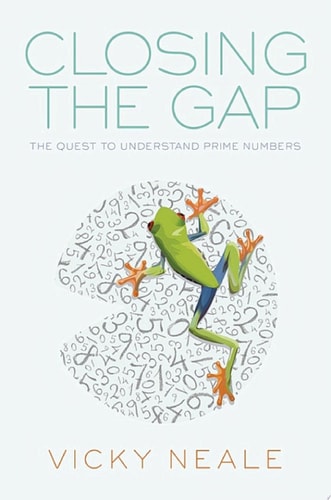
Closing the Gap: The Quest to Understand Prime Numbers
0
0
As an Amazon Associate and affiliate partner, Menrva Books earns from qualifying purchases. Learn more
Author Description
In 2013, a little known mathematician in his late 50s stunned the mathematical community with a breakthrough on an age-old problem about prime numbers. Since then, there has been further dramatic progress on the problem, thanks to the efforts of a large-scale online collaborative effort of a type that would have been unthinkable in mathematics a couple of decades ago, and the insight and creativity of a young mathematician at the start of his career. Prime numbers have intrigued, inspired and infuriated mathematicians for millennia. Every school student studies prime numbers and can appreciate their beauty, and yet mathematicians' difficulty with answering some seemingly simple questions about them reveals the depth and subtlety of prime numbers. Vicky Neale charts the recent progress towards proving the famous Twin Primes Conjecture, and the very different ways in which the breakthroughs have been made: a solo mathematician working in isolation and obscurity, and a large collaboration that is more public than any previous collaborative effort in mathematics and that reveals much about how mathematicians go about their work. Interleaved with this story are highlights from a significantly older tale, going back two thousand years and more, of mathematicians' efforts to comprehend the beauty and unlock the mysteries of the prime numbers.
Menrva's Summary
THE THESIS
This book investigates the recent, rapid advancements in understanding prime numbers, specifically the Twin Primes Conjecture, and the evolving methodologies of modern mathematical research. Vicky Neale, a mathematician and educator, synthesizes the history of prime number theory with the contemporary breakthroughs achieved by Yitang Zhang and the Polymath Project. She argues that these developments represent a shift in how mathematical discovery occurs, contrasting solitary genius with large-scale, open-source collaboration.
THE SCOPE MAP
What You Will Find
- Historical overview of prime number theory spanning two millennia
- Detailed account of Yitang Zhang's 2013 breakthrough on bounded gaps between primes
- Analysis of the Polymath Project's collaborative methodology
- Explanation of the Twin Primes Conjecture and related mathematical problems
Scope Limits
- The text does not provide a comprehensive textbook-level proof of all theorems mentioned
- It focuses primarily on the recent history of prime gaps rather than the entirety of number theory
THE AUTHORITY PERSPECTIVE
Experts and readers alike praise the book for its accessibility in explaining complex mathematical concepts to a general audience. It is widely regarded as a clear and engaging account of how modern mathematical research functions in the digital age.
Page Count:
171
Publication Date:
2017-01-01
Publisher:
OUP Oxford
ISBN-10:
0191092444
ISBN-13:
9780191092442
Non-Fiction
Biography
Mathematics - General
Mathematics Statistics
Science History
Numbers Prime
Mathematics
Number Theory
Community Tags
Similar Books