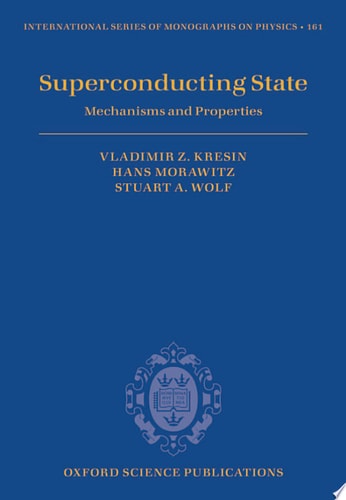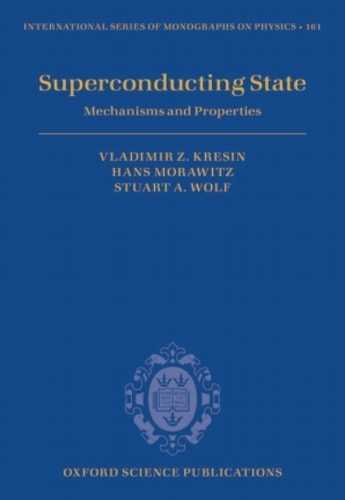
Superconducting State: Mechanisms and Properties
0
0
As an Amazon Associate and affiliate partner, Menrva Books earns from qualifying purchases. Learn more
Author Description
Superconducting State provides a very detailed theoretical treatment of the key mechanisms of superconductivity, including the current state of the art (phonons, magnons, and plasmons). A very complete description is given of the electron-phonon mechanism responsible for superconductivity in the majority of superconducting systems, and the history of its development, as well as a detailed description of the key experimental techniques used to study the superconducting state and determine the mechanisms. In addition, there are chapters describing the discovery and properties of the key superconducting compounds that are of the most interest for science, and applications including a special chapter on the cuprate superconductors. It provides detailed treatments of some very novel aspects of superconductivity, including multiple bands (gaps), the "pseudogap" state, novel isotope effects beyond BCS, and induced superconductivity.
Menrva's Summary
THE THESIS
This text investigates the fundamental mechanisms and physical properties that define the superconducting state across various materials. The authors, Hans Morawitz, Stuart A. Wolf, and Vladimir Z. Kresin, leverage their extensive expertise in condensed matter physics to synthesize theoretical frameworks and experimental data. They provide a rigorous examination of electron-phonon interactions, alongside emerging theories regarding magnons and plasmons, to explain the behavior of superconducting systems.
THE SCOPE MAP
What You Will Find
- Theoretical analysis of electron-phonon mechanisms and BCS theory extensions
- Detailed examination of cuprate superconductors and multiple band systems
- Discussion of the pseudogap state and novel isotope effects
- Overview of experimental techniques for characterizing superconducting materials
Scope Limits
- The text focuses primarily on theoretical and experimental physics rather than industrial engineering applications
- It assumes a high level of prior knowledge in quantum mechanics and solid-state physics
THE AUTHORITY PERSPECTIVE
Experts recognize this volume as a comprehensive reference for researchers and graduate students specializing in condensed matter physics. Readers frequently note the high academic density of the prose, which serves as a foundational resource for understanding complex superconducting phenomena.
Page Count:
272
Publication Date:
2013-01-01
Publisher:
OUP Oxford
ISBN-10:
0191002259
ISBN-13:
9780191002250
Science
Physics
Earth Sciences
Academic
Condensed Matter Physics