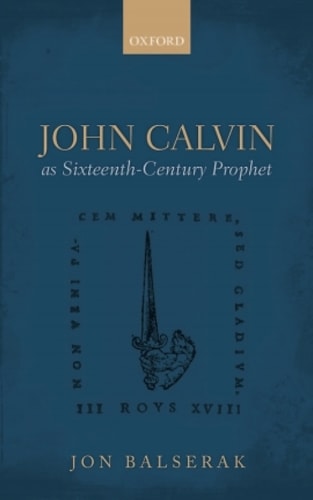
John Calvin as Sixteenth-Century Prophet
0
0
As an Amazon Associate and affiliate partner, Menrva Books earns from qualifying purchases. Learn more
Author Description
John Calvin as Sixteenth-Century Prophet examines Calvin's sense of vocation. Jon Balserak argues that Calvin believed himself to be a prophet "placed over nations and kingdoms to tear down and destroy, to build and to plant" (Jer 1: 10). With this authority, Calvin pursued an expansionist agenda which blended the religious, political, and social towards making France, upon which he turned his attentions especially after 1555, Protestant. Beginning with an analysis of the two trajectories of thought existing within Christian discourse on prophecy from the patristic to the Early Modern era, this study goes on to locate Calvin within a non-mystical, non-apocalyptic prophetic tradition that focused on scriptural interpretation. Balserak demonstrates how Calvin developed a plan to win France for the gospel; a plan which included the possibility of armed conflict. To pursue his designs, Calvin trained "prophets" who were sent into France to labor intensely to undermine the king's authority on the grounds that he supported idolatry, convince the French Reformed congregations that they were already in a war with him, and prepare them for a possible military uprising. An additional part of this plan saw Calvin search for a French noble willing to support the evangelical religion, even if it meant initiating a coup. Calvin began ruminating over these ideas in the 1550s or possibly earlier. In this analysis, the war which commenced in 1562 represents the culmination of Calvin's years of preparation.
Menrva's Summary
THE THESIS
This study investigates the extent to which John Calvin perceived his own vocation through the lens of a biblical prophet, specifically examining how this self-conception influenced his political and religious strategies in sixteenth-century France. Author Jon Balserak, a scholar of the Reformation, utilizes primary source correspondence and theological writings to argue that Calvin adopted a non-mystical, scriptural-based prophetic identity. This framework allowed Calvin to justify an expansionist agenda that sought to transform France into a Protestant nation, even at the cost of civil stability and armed conflict.
THE SCOPE MAP
What You Will Find
- Analysis of the historical trajectory of prophetic discourse from the patristic era to the Early Modern period.
- Examination of Calvin's specific strategies for undermining French royal authority.
- Documentation of Calvin's efforts to recruit French nobility for evangelical political objectives.
- Investigation into the theological justifications for military uprising against perceived idolatry.
Scope Limits
- The study focuses primarily on Calvin's activities regarding France after 1555.
- It does not provide a comprehensive biography of Calvin's entire life or his work in Geneva outside of this specific prophetic framework.
THE AUTHORITY PERSPECTIVE
Scholars recognize this work as a significant contribution to understanding the political dimensions of Calvin's theology. Readers frequently note the academic density of the prose and the author's meticulous use of historical evidence to challenge traditional perceptions of Calvin as a purely passive theologian.
Page Count:
208
Publication Date:
2014-01-01
Publisher:
OUP Oxford
ISBN-10:
0191008273
ISBN-13:
9780191008276
Religion
History
Biography
Theology
Reformation
Community Tags
Other Editions(4)
Similar Books
Reader Comments
Share Your Thoughts
No comments yet. Be the first to share your thoughts!