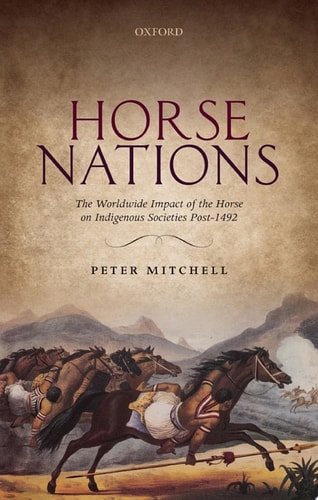
Horse Nations: The Worldwide Impact of the Horse on Indigenous Societies Post-1492
0
0
As an Amazon Associate and affiliate partner, Menrva Books earns from qualifying purchases. Learn more
Author Description
The Native American on a horse is an archetypal Hollywood image, but though such equestrian-focused societies were a relatively short-lived consequence of European expansion overseas, they were not restricted to North America's Plains. Horse Nations provides the first wide-ranging and up-to-date synthesis of the impact of the horse on the Indigenous societies of North and South America, southern Africa, and Australasia following its introduction as a result of European contact post-1492. Drawing on sources in a variety of languages and on the evidence of archaeology, anthropology, and history, the volume outlines the transformations that the acquisition of the horse wrought on a diverse range of groups within these four continents. It explores key topics such as changes in subsistence, technology, and belief systems, the horse's role in facilitating the emergence of more hierarchical social formations, and the interplay between ecology, climate, and human action in adopting the horse, as well as considering how far equestrian lifestyles were ultimately unsustainable.
Menrva's Summary
THE THESIS
This volume investigates the transformative impact of the horse on Indigenous societies across North and South America, southern Africa, and Australasia following the onset of European contact in 1492. Peter Mitchell, an expert in African archaeology and history, synthesizes diverse archaeological, anthropological, and historical records to analyze how the introduction of the horse altered subsistence patterns, social hierarchies, and belief systems. The work argues that while equestrian societies became iconic, their development was a complex, multi-continental phenomenon shaped by ecological constraints and human agency.
THE SCOPE MAP
What You Will Find
- Comparative analysis of equestrian adoption in North America, South America, southern Africa, and Australasia.
- Examination of shifts in technology, subsistence strategies, and social stratification.
- Discussion of the interplay between climate, ecology, and the sustainability of horse-based lifestyles.
- Integration of multi-lingual primary sources and archaeological evidence.
Scope Limits
- The study focuses specifically on the period following 1492 and does not cover pre-contact equestrian history.
- The analysis is limited to the four specified geographic regions and does not provide a global survey of all horse-using cultures.
THE AUTHORITY PERSPECTIVE
Scholars recognize this text as a significant comparative study that bridges regional histories often treated in isolation. Readers frequently note the academic rigor and the breadth of the synthesis, which provides a foundational framework for understanding the global consequences of the horse's reintroduction to these continents.
Page Count:
460
Publication Date:
2015-01-01
Publisher:
OUP Oxford
ISBN-10:
0191008826
ISBN-13:
9780191008825
History
Horses
Anthropology
Colonialism
Horsemanship
Archaeology
Community Tags
Similar Books