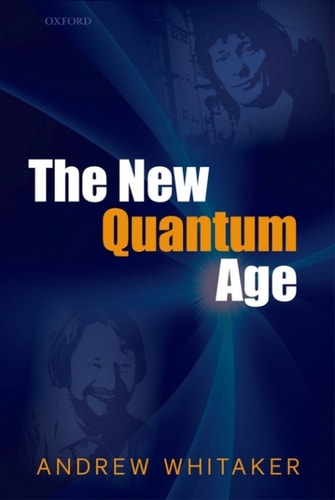
The New Quantum Age: From Bell's Theorem to Quantum Computation and Teleportation
0
0
As an Amazon Associate and affiliate partner, Menrva Books earns from qualifying purchases. Learn more
Author Description
While quantum theory has been used to study the physical universe with great profit, both intellectual and financial, ever since its discovery eighty-five years ago, over the last fifty years we have found out more and more about the theory itself, and what it tells us about the universe. It seems we may have to accept non-locality - cause and effect may be light-years apart; loss of realism - nature may be fundamentally probabilistic; and non-determinism - it seems that God does play dice! This book, totally up-to-date and written by an expert in the field, explains the emergence of our new perspective on quantum theory, but also describes how the ideas involved in this re-evaluation led seamlessly to a totally new discipline - quantum information theory. This discipline includes quantum computation, which is able to perform tasks quite out of the range of other computers; the totally secure algorithms of quantum cryptography; and quantum teleportation - as part of science fact rather than science fiction. The book is the first to combine these elements, and will be of interest to anybody interested in fundamental aspects of science and their application to the real world.
Menrva's Summary
THE THESIS
This book investigates the shift in understanding quantum theory from a tool for physical study to a foundational framework for information science. Andrew Whitaker, a physicist with expertise in the history and development of quantum mechanics, synthesizes decades of research to explain how concepts like non-locality and non-determinism have reshaped our view of reality. He argues that these theoretical re-evaluations are not merely abstract, but serve as the direct precursors to the practical emergence of quantum information theory.
THE SCOPE MAP
What You Will Find
- Historical development of quantum theory over the last eighty-five years
- Analysis of Bell's Theorem and its implications for non-locality
- Technical overview of quantum computation and cryptography
- Scientific explanation of quantum teleportation
Scope Limits
- Does not provide a comprehensive textbook-level derivation of all quantum mathematical proofs
- Does not focus on speculative or fringe interpretations of quantum mechanics beyond established scientific consensus
THE AUTHORITY PERSPECTIVE
Readers frequently note the clarity with which Whitaker bridges the gap between abstract theoretical physics and modern technological applications. Experts highlight this as a useful synthesis for those seeking to understand how fundamental scientific shifts lead to new computational disciplines.
Page Count:
408
Publication Date:
2011-01-01
Publisher:
OUP Oxford
ISBN-10:
0191004820
ISBN-13:
9780191004827
Non-Fiction
Science
Information Theory
Earth Sciences
Physics
Community Tags
Similar Books