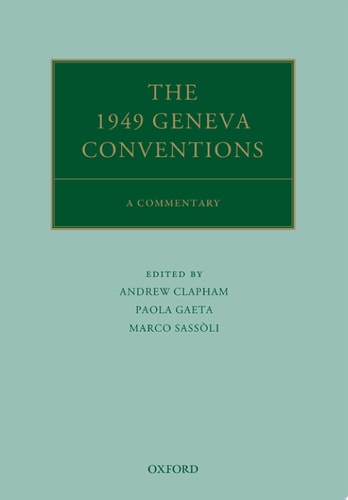
The 1949 Geneva Conventions: A Commentary
0
0
As an Amazon Associate and affiliate partner, Menrva Books earns from qualifying purchases. Learn more
Author Description
The four Geneva Conventions, adopted in 1949, remain the fundamental basis of contemporary international humanitarian law. They protect the wounded and sick on the battlefield, those wounded, sick or shipwrecked at sea, prisoners of war, and civilians in time of war. However, since they were adopted warfare has changed considerably. In this groundbreaking commentary over sixty international law experts investigate the application of the Geneva Conventions and explain how they should be interpreted today. It places the Conventions in the light of the developing obligations imposed by international law on states, armed groups, and individuals, most notably through international human rights law and international criminal law. The context in which the Conventions are to be applied and interpreted has changed considerably since they were first written. The borderline between international and non-international armed conflicts is not as clear-cut as was once thought, and is complicated further by the use of armed force mandated by the United Nations and the complex mixed and transnational nature of certain non-international armed conflicts. The influence of other developing branches of international law, such as human rights law and refugee law has been considerable. The development of international criminal law has breathed new life into multiple provisions of the Geneva Conventions. This commentary adopts a thematic approach to provide detailed analysis of each key issue dealt with by the Conventions, taking into account both judicial decisions and state practice. Cross-cutting chapters on issues such as transnational conflicts and the geographical scope of the Conventions also give readers a full understanding of the meaning of the Geneva Conventions in their contemporary context. Prepared under the auspices of the Geneva Academy of International Humanitarian Law and Human Rights, this commentary on four of the most important treaties in international law is unmissabl
Menrva's Summary
THE THESIS
This work investigates how the 1949 Geneva Conventions, the foundational pillars of international humanitarian law, must be interpreted and applied within the complexities of modern warfare. Andrew Clapham, alongside a collective of over sixty international law experts, provides a comprehensive commentary that reconciles the original treaty language with contemporary developments in state practice, human rights law, and international criminal law. The text evaluates the shifting boundaries between international and non-international armed conflicts, offering a framework for applying these treaties to modern, transnational, and non-state actor scenarios.
THE SCOPE MAP
What You Will Find
- Detailed thematic analysis of the four 1949 Geneva Conventions.
- Examination of the intersection between humanitarian law, human rights law, and refugee law.
- Analysis of judicial decisions and state practice regarding the application of armed force.
- Cross-cutting chapters on geographical scope and the nature of transnational conflicts.
Scope Limits
- The text focuses on legal interpretation and commentary rather than a historical narrative of the 1949 drafting process.
- It does not provide a comprehensive history of every individual conflict since 1949, but rather uses them as case studies for legal application.
THE AUTHORITY PERSPECTIVE
Experts and legal scholars recognize this commentary as a primary resource for understanding the current application of international humanitarian law. Readers frequently note the academic density of the prose, which is intended for practitioners, researchers, and students of international law.
Page Count:
1400
Publication Date:
2015-01-01
Publisher:
Oxford University Press
ISBN-10:
0191003522
ISBN-13:
9780191003523
International Law
Reference
Military History
Human rights
Law
Community Tags
Similar Books