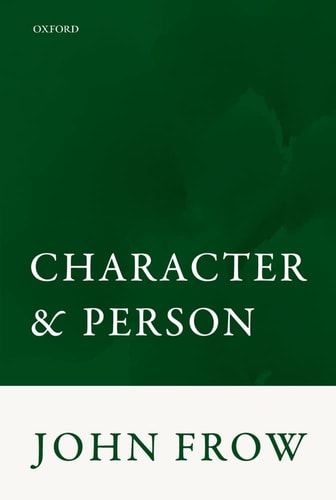
Character and Person
0
0
As an Amazon Associate and affiliate partner, Menrva Books earns from qualifying purchases. Learn more
Author Description
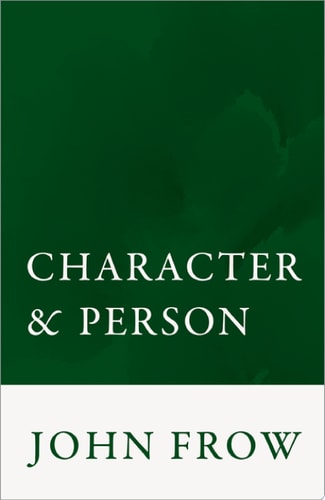
Fictional character is an ontologically ambivalent category -- at once a formal construct and a quasi-person -- which lies at the heart of the life of textual fictions of all kinds. Character and Person explores that ambivalence by investigating not only the kinds of thing that character is but how it works to engage readers and the range of typologies through which it has been constructed in very different periods, media, and genres. John Frow seeks to explore the ways in which character is person-like, and through that the question of what it means to be a social person. His focus is thus on the interaction between its two major categories, and its method involves a constant play back and forth between them: from philosophical theories of face to an account of the mask in the New Comedy; from an exploration of medieval beliefs about the body's existence in the afterlife to a reading of Dante's Purgatorio; from the history of humoral medicine to the figure of the melancholic in Jacobean drama; and from Proust and Pessoa to cognitive science. What develops from this methodological commitment to fusing the categories of character and person is an extended analysis of the schemata that underpin each of them in their distinct but mutually constitutive spheres of operation.
Menrva's Summary
THE THESIS
How does the ontological status of the fictional character intersect with the social construction of the human person? John Frow, a scholar of literary theory and cultural studies, utilizes a multidisciplinary framework to examine the tension between textual constructs and real-world personhood. By synthesizing philosophical, historical, and cognitive perspectives, he argues that the mechanisms used to build fictional characters are deeply linked to the ways society defines and perceives individual identity.
THE SCOPE MAP
What You Will Find
- Philosophical theories of the face and the mask in New Comedy
- Historical analysis of humoral medicine and the melancholic figure in Jacobean drama
- Interpretations of medieval body concepts in Dante's Purgatorio
- Integration of cognitive science and modern literature including Proust and Pessoa
Scope Limits
- Does not provide a comprehensive history of all literary characterization
- Does not offer a prescriptive guide for creative writing or character development
THE AUTHORITY PERSPECTIVE
Scholars and critics recognize this work as a dense, rigorous exploration of the intersection between literary theory and social ontology. It is frequently cited as a sophisticated resource for those interested in the philosophical underpinnings of character construction across diverse historical and media contexts.
Page Count:
352
Publication Date:
2014-01-01
Publisher:
OUP Oxford
ISBN-10:
0191009695
ISBN-13:
9780191009693
Philosophy
English
Literature
In literature
English & College Success
Sociology
Literary theory
Fiction
Literary Criticism
Community Tags
Other Editions(3)

Similar Books