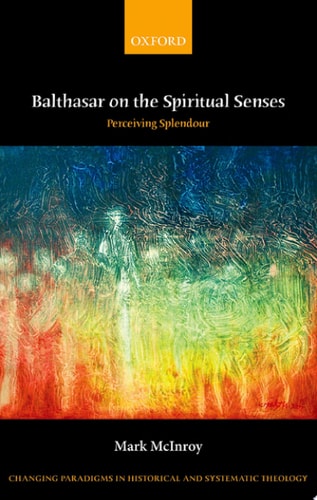
Balthasar on the Spiritual Senses: Perceiving Splendour
0
0
As an Amazon Associate and affiliate partner, Menrva Books earns from qualifying purchases. Learn more
Author Description
In this study, Mark McInroy argues that the 'spiritual senses' play a crucial yet previously unappreciated role in the theological aesthetics of Hans Urs von Balthasar. The doctrine of the spiritual senses typically claims that human beings can be made capable of perceiving non-corporeal, 'spiritual' realities. After a lengthy period of disuse, Balthasar recovers the doctrine in the mid-twentieth century and articulates it afresh in his theological aesthetics. At the heart of this project stands the task of perceiving the absolute beauty of the divine form through which God is revealed to human beings. Although extensive scholarly attention has focused on Balthasar's understanding of revelation, beauty, and form, what remains curiously under-studied is his model of the perceptual faculties through which one beholds the form that God reveals. McInroy claims that Balthasar draws upon the tradition of the spiritual senses in order to develop the means through which one perceives the 'splendour' of divine revelation. McInroy further argues that, in playing this role, the spiritual senses function as an indispensable component of Balthasar's unique, aesthetic resolution to the high-profile debates in modern Catholic theology between Neo-Scholastic theologians and their opponents. As a third option between Neo-Scholastic 'extrinsicism', which arguably insists on the authority of revelation to the point of disaffecting the human being, and 'immanentism', which reduces God's revelation to human categories in the name of relevance, McInroy proposes that Balthasar's model of spiritual perception allows one to be both delighted and astounded by the glory of God's revelation.
Menrva's Summary
THE THESIS
This study investigates the neglected role of the 'spiritual senses' within the theological aesthetics of Hans Urs von Balthasar, arguing that they are essential for understanding his model of divine perception. Mark McInroy, a scholar of modern Catholic theology, examines how Balthasar recovers this historical doctrine to bridge the gap between Neo-Scholastic extrinsicism and modern immanentism. By analyzing Balthasar's writings, McInroy demonstrates that the spiritual senses provide the necessary faculties for humans to perceive the 'splendour' of divine revelation without compromising either divine authority or human relevance.
THE SCOPE MAP
What You Will Find
- An analysis of the historical development of the doctrine of spiritual senses.
- A detailed examination of Balthasar's theological aesthetics and his concept of the 'divine form'.
- A comparative study of mid-twentieth-century Catholic theological debates.
Scope Limits
- The text does not provide a general introduction to Balthasar's entire corpus.
- It does not offer a comprehensive history of the spiritual senses outside of their specific application in Balthasar's work.
THE AUTHORITY PERSPECTIVE
Scholars and theologians identify this work as a significant contribution to Balthasar studies, particularly for its focus on the perceptual mechanisms of his aesthetic theology. Readers frequently note the academic density of the prose, which is intended for an audience familiar with systematic theology and the specific debates of the mid-twentieth-century Catholic tradition.
Page Count:
240
Publication Date:
2014-01-01
Publisher:
OUP Oxford
ISBN-10:
0191002941
ISBN-13:
9780191002946
Religion
Catholic Theology
Philosophy of
Theology
Theology doctrinal
Spirituality
Theological Aesthetics
Systematic Theology
Community Tags
Similar Books