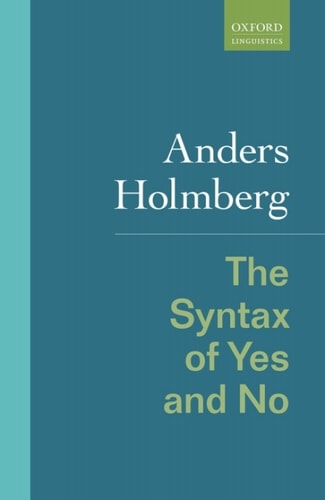
The Syntax of Yes and No
0
0
As an Amazon Associate and affiliate partner, Menrva Books earns from qualifying purchases. Learn more
Author Description
This book is a cross-linguistic study of the syntax of yes-no questions and their answers, drawing on data from a wide range of languages with particular focus on English, Finnish, Swedish, Thai, and Chinese. There are broadly two types of answer to yes-no questions: those that employ particles such as 'yes' and 'no' (as found in English) and those that echo a part of the question, usually the finite verb, with or without negation (as found in Finnish). The latter are uncontroversially derived by ellipsis, while the former have been claimed to be clause substitutes. Anders Holmberg argues instead that even answers that employ particles are complete sentences, derived by ellipsis from full sentential expressions, and that the two types share essential syntactic properties. The book also examines the related cross-linguistic and intralinguistic variation observed in answers to negative questions such as 'does he not drink coffee?', whereby 'yes' in one language appears to correspond to 'no' in another. The book illustrates how a seemingly trivial phenomenon can have the most wide-ranging consequences for theories of language, and will be of interest not only to theoretical linguists but also to students and scholars of typological and descriptive linguistics.
Menrva's Summary
THE THESIS
This book investigates the underlying syntactic structure of yes-no questions and their corresponding answers across diverse linguistic systems. Anders Holmberg, a specialist in generative syntax, utilizes a comparative framework to challenge the traditional classification of answer particles. By analyzing data from languages including English, Finnish, Swedish, Thai, and Chinese, he argues that answer particles are not merely clause substitutes but are derived through ellipsis from full sentential structures.
THE SCOPE MAP
What You Will Find
- Comparative analysis of particle-based versus verb-echo answer systems
- Theoretical exploration of ellipsis as a universal mechanism in question-answer pairs
- Examination of cross-linguistic variation in responses to negative questions
- Syntactic modeling of sentential derivation
Scope Limits
- Does not provide a comprehensive survey of every global language family
- Focuses primarily on formal syntactic theory rather than sociolinguistic or pragmatic usage
THE AUTHORITY PERSPECTIVE
Experts recognize this work as a significant contribution to formal syntax and comparative linguistics. Readers frequently note the technical density of the prose, making it most suitable for advanced students and professional researchers in the field.
Page Count:
252
Publication Date:
2015-01-01
Publisher:
OUP Oxford
ISBN-10:
0191005363
ISBN-13:
9780191005367
Syntax
Academic
English & College Success
Questioning
English
Typology
Linguistics